
Preparing for CAT While Working Full Time: A Realistic Weekday Structure
A CAT plan built for the ninety usable minutes a workday actually leaves you, with weekend mock blocks, a weekly time grid and a rule for losing a week without losing the plan.
By Shiva Guru N · 14 November 2026
Most CAT timetables you find online quietly assume you have the whole day. Eight hours of study, three slots of practice, a mock every other day. If you work full time and copy one of those plans, you will feel behind by Wednesday and guilty by Sunday, and neither feeling does anything for your score.
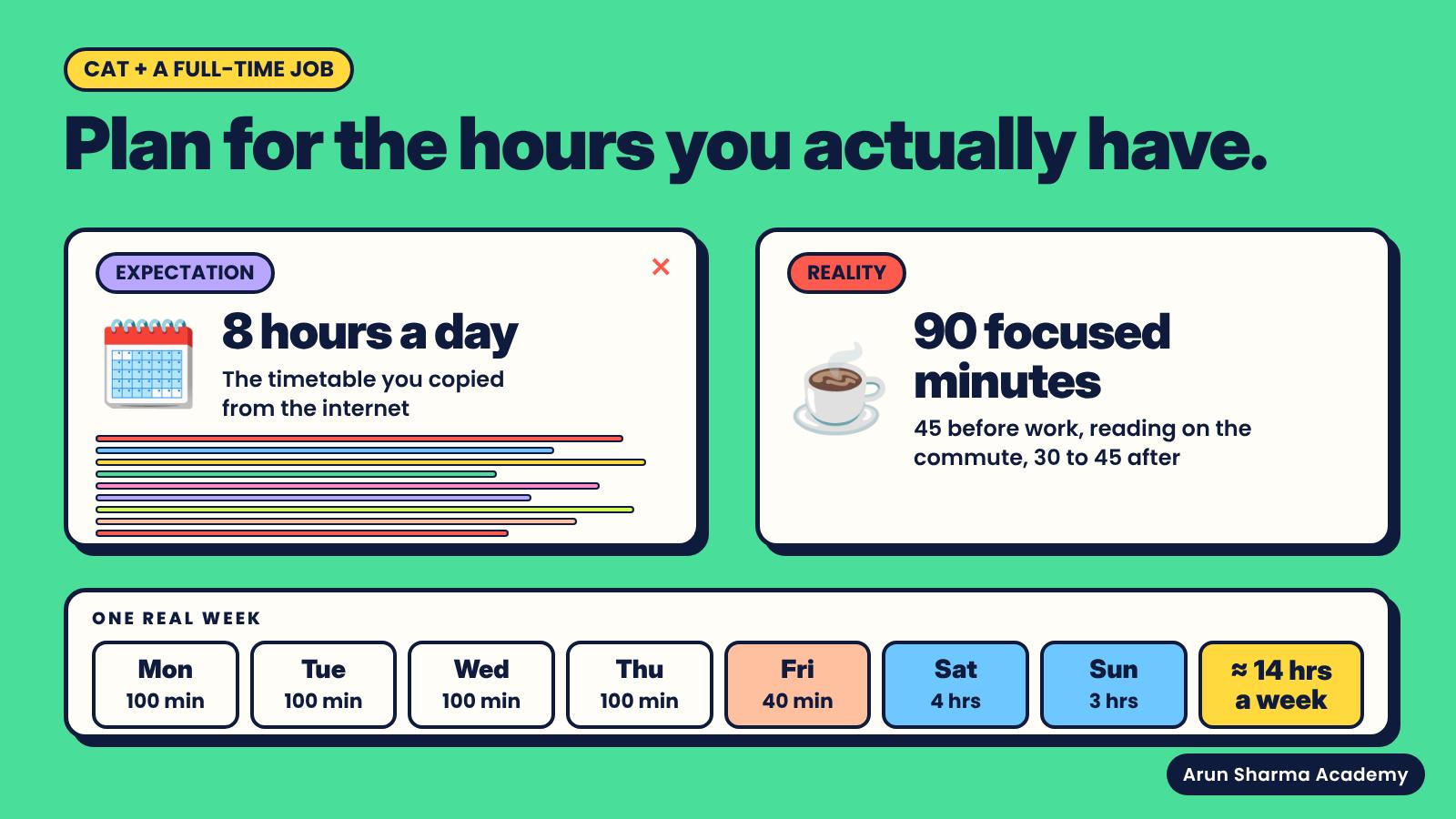
Plenty of people prepare for CAT while holding down a job. What works for them is rarely a heroic schedule. It is a plan built for the hours they really have, which usually means about ninety focused minutes on a working day and two longer blocks at the weekend, kept going for months.
How should you prepare for CAT while working full time?
Plan for about 90 focused minutes on weekdays, split into a morning block for concepts and a shorter evening block for timed practice. Add two long weekend blocks, one for a mock and one for its analysis. That comes to roughly fifteen hours a week. Steady weeks beat occasional marathon weekends.
What ninety minutes a day can genuinely cover
Do the arithmetic once, honestly. Ninety minutes on five weekdays is seven and a half hours. Two weekend blocks of three to four hours each add another six to eight. Call it fifteen hours a week. Over thirty weeks, that is around 450 hours.
That is enough time to prepare well, and not enough to do everything. Something has to give, and it is far better to choose what than to find out in October. The usual candidates:
- a second and third reading of theory you have already understood
- the rarest topics in the syllabus, until the common ones are secure
- a second or third test series, when one series analysed properly is worth more
- practice material without solutions, which takes hours to check
What you keep is whatever returns the most marks: the core of QA, especially arithmetic and algebra, reading every day for VARC, and a steady supply of DILR sets with honest review. If you are preparing DILR on your own, Practising DILR Without a Coaching Institute explains where good sets come from.
The weekday blocks
Morning block, about 45 minutes, before work. Use it for new concepts or your hardest practice, while your head is still clear. Recorded lessons suit this slot because they wait for you, whether you sit down at 6:00 or 6:40. If evenings leave you drained, put QA and DILR here and keep the lighter work for later.
Commute or lunch, about 20 to 30 minutes. This is reading time: one long-form essay, then a three-line summary of the author's argument typed into your phone. What to Read Every Day for CAT VARC gives you a rota of subjects and sources. If you drive to work, skip this slot rather than forcing it.
Evening block, about 30 to 45 minutes. Timed practice only: one DILR set, or ten QA questions, or two RC passages. Then spend two minutes adding anything that went wrong to your error log.
The fifteen-minute floor. Some days will be bad: a late meeting, a deadline, a sick child. On those days, do fifteen minutes and stop. One RC passage, or one DILR set you have solved before. Keeping the habit alive matters more than the size of the dose, and a fifteen-minute day keeps tomorrow's ninety minutes possible.
Weekends: the mock and the analysis
The weekend is where the weekday work gets tested. The most common mistake is placing the mock on Sunday evening, which pushes the analysis into Monday, where it quietly never happens.
A better pattern, once you start taking full mocks:
- Saturday morning: a full-length mock, at the time of day your CAT slot is likely to be
- Saturday afternoon: the first round of analysis, while every choice you made is still fresh
- Sunday morning: the second round of analysis, with re-attempts of the questions you got wrong
- Sunday afternoon: one topic block, chosen by what the analysis found
- Sunday evening: off
Early in your preparation, before regular mocks begin, use the same two blocks for topic work and one sectional test. Sectional Mocks vs Full-Length Mocks explains when to make the switch, and why analysis deserves about twice the time of the test itself.
The weekly time grid
Here is one full week, laid out for the stage when you are taking a full mock every weekend. Treat the minutes as a template and move the subjects around to suit your weak areas.
| Day | Morning, before work | Commute or lunch | Evening | Main focus |
|---|---|---|---|---|
| Monday | 45 min QA concepts | 25 min reading and summary | 30 min QA practice | Quant |
| Tuesday | 45 min DILR sets | 25 min reading and summary | 30 min DILR review | DILR |
| Wednesday | 45 min RC practice | 25 min reading and summary | 30 min QA practice | VARC and Quant |
| Thursday | 45 min on your weaker of QA and DILR | 25 min reading and summary | 30 min mixed practice | Weakest section |
| Friday | The fifteen-minute floor | 25 min reading and summary | Off | Recovery |
| Saturday | 2 hr full-length mock | Off | 2 hr analysis, round one | Testing |
| Sunday | 1 hr 30 min analysis, round two | Off | 1 hr 30 min topic fix | Fixing |
That comes to a little over fourteen hours. The grid leaves Friday evening and Sunday evening free on purpose. A plan with no slack in it breaks the first time work gets busy.
Travel weeks, appraisals and the rest of real life
You will lose weeks. Quarter-end, appraisal season, a family wedding, a work trip. The plan needs a rule for those weeks, decided in advance.
The catch-up rule: never try to repay a lost week in full. Doubling up the following week usually leads to a second lost week. Instead, move the whole plan back by one week, keep your next scheduled mock, and drop the lowest-priority topic from your list.
Heavy work weeks: switch to the fifteen-minute floor every day and skip the mock that weekend. A week at the floor is far better than a week at zero, because the habit survives it.
Travel: airports, trains and hotel evenings suit reading and error-log revisits, which need nothing more than your phone and a few printed sheets.
FAQs
How many months does a working professional need to prepare for CAT? It depends on where you start. Eight to ten months at around fifteen hours a week is a sensible range for most people starting from scratch. Take one diagnostic mock first, because it tells you more about your own timeline than any general advice can.
Should I quit my job to prepare for CAT? For most people, no. A job gives you income and a daily structure, and many IIMs give some weight to work experience in their selection process. Quitting removes the structure and adds pressure, and the extra hours rarely turn into a proportionally better score.
Should I take leave before CAT? A few days of leave in the final fortnight can help, for one or two last mocks and proper rest. Long leave rarely does, because unstructured days tend to fill with anxiety rather than study.
Does work experience help in IIM admissions? It can. Several IIMs include work experience in the scores they use for shortlisting or final selection, and each one sets its own rules on how much experience counts and how it is scored. Check the admission policy of every institute you are targeting.
With a job, the plan has to fit the week you really have, and a week like the one above can carry you a long way. S.C.A.L.E. Combo gives your weekday blocks a structured route through all three sections, The CAT Experience test series supplies the weekend mocks, and if you are starting now with next year's exam in mind, the CAT 2027 Success Program gives you the full runway.