
What to Read Every Day for CAT VARC, and What Is Quietly Wasting Your Time
Reading more doesn't help on its own. A daily CAT reading plan built around the kinds of passages the exam actually uses, and the popular habits that don't carry over.
By Shiva Guru N · 9 October 2026
At some point in your CAT preparation, someone has told you to read more. It is good advice that almost never comes with instructions. So you read: a novel at night, the newspaper over breakfast, a few articles saved on your phone. Weeks pass, and your RC accuracy stays exactly where it was. That is discouraging, and it leads many students to decide that VARC simply can't be improved. It can. Reading helps when what you read looks like what CAT asks you to read, and when you do something with it afterwards.
What should you read every day for CAT VARC?
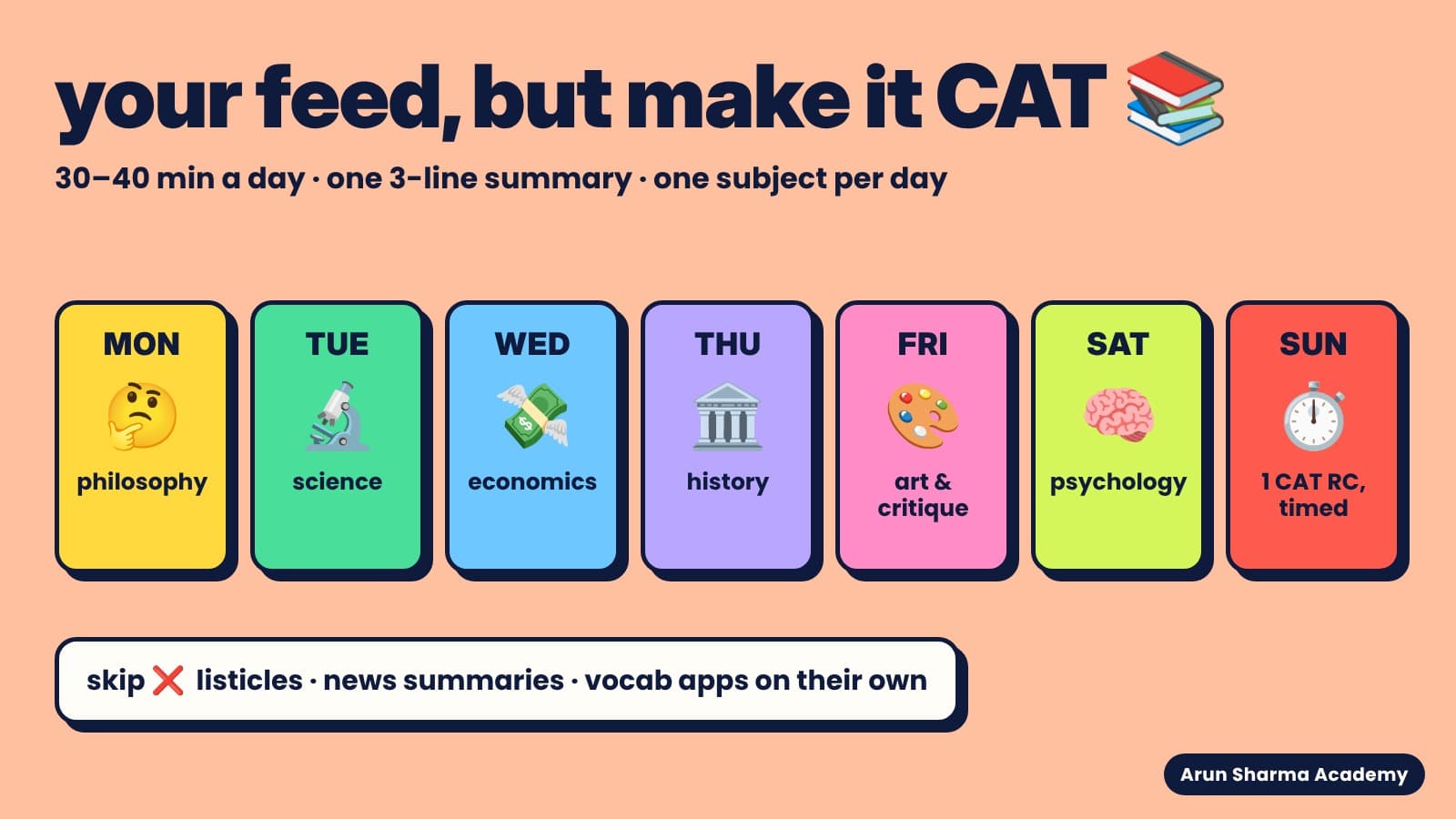
Read 30 to 40 minutes of serious non-fiction each day, rotating across the subjects CAT passages come from: philosophy, science, economics, history, the arts and psychology. Choose long-form essays over news. After each piece, write a three-line summary of the author's argument.
The kinds of passages CAT keeps coming back to
Look through the reading comprehension passages in recent CAT papers and a pattern appears. Very few are news. Most are extracts from essays and books written for thoughtful general readers. The subjects range widely: questions from philosophy and ethics, how science works and where it goes wrong, how economies and people behave, history and culture, art and literary criticism, and how societies think and live.
In CAT 2025, reading comprehension made up 16 of the 24 VARC questions, across four passages, according to published analyses of the paper. Reading is most of the section, so your daily reading is preparation for most of its marks.
What these passages share matters more than their subjects. In each one, an author is building an argument, often against some other view. The questions then test whether you followed that argument: the main claim, what it assumes, where the author stands, and what would follow from it. The subject is only the setting.
So your daily reading should look the same. You need pieces that argue something, and you need variety, so that no subject on exam day feels foreign.
Where to find each kind of reading
You don't need to subscribe to everything. Two or three good sources per subject is plenty.
- Philosophy and ideas: Aeon and Psyche publish free long-form essays in exactly the style CAT likes.
- Science: Scientific American, Smithsonian Magazine, Nautilus and BBC Future explain research for non-specialists.
- Economics and business: The Economist, Harvard Business Review, and the opinion pages of Mint or The Indian Express.
- History and culture: History Today, JSTOR Daily, and the long reads in The Guardian.
- Arts and criticism: essays in The Atlantic or The New Yorker, and book reviews in any serious newspaper.
- Psychology and society: Psyche, Big Think, and the science sections of major papers.
- Everything at once: Arts & Letters Daily links to a handful of serious essays every day, across all of these subjects.
For structured practice alongside your reading, How to Prepare for Verbal Ability and Reading Comprehension for CAT by Arun Sharma and Meenakshi Upadhyay covers the question types with practice passages. You can find it among Arun Sharma's CAT books.
Some of these limit free articles each month. Rotating between them usually keeps you within the free allowance.
Two cautions. Don't lean on a single website because someone online said CAT takes passages from it. CAT draws on a wide range of writing, and being comfortable with variety is the real skill. And keep newspaper editorials in their place. They are short and good practice for following an argument, and they help later with group discussions and interviews, but on their own they are lighter than most CAT passages.
The summary habit that turns reading into marks
Reading without checking yourself is how months go by with no change. The fix takes three minutes a day.
When you finish a piece, close it and write three lines. First, what the author is arguing. Second, the main reason or evidence they give. Third, what they are arguing against, or who would disagree with them. Then open the piece again and see how close you were.
In the first week, you will often get the third line wrong or leave it blank. That is the useful part. A lot of CAT questions sit exactly in the gap between what a passage says and what it is pushing back against. Highlighting doesn't train that. Summarising from memory does.
The seven-day reading rota
Here is one way to spread the week. Change the order to suit you, but keep the spread.
- Monday: a philosophy or ethics essay
- Tuesday: a science or technology piece
- Wednesday: an economics or business analysis
- Thursday: a history or culture long read
- Friday: art, literature or film criticism
- Saturday: a psychology or society essay
- Sunday: one RC passage from a previous CAT paper, timed, then a look back at the week's six summaries
Thirty to forty minutes a day, one summary a day. If you miss a day, skip it rather than doubling up the next day. Reading steadily matters more than catching up.
What quietly wastes your time
None of these are bad habits. They just carry over to CAT less than people hope.
Bingeing fiction builds stamina and a love of reading, which matter. But novels rarely argue a point the way a CAT passage does, so they don't train the questions.
Listicles, news summaries and explainer threads feel efficient. The trouble is that someone has already digested them for you, and that digesting is exactly the skill CAT tests.
Vocabulary apps used on their own teach words without context. Words you meet in your reading, and look up when you meet them, stay longer and come with a feel for how they are used.
Speed-reading tricks usually trade understanding for pace. In RC, a missed word like "rarely" or "only" costs more than a slow minute.
FAQs
How many minutes a day should I read for CAT? Thirty to forty minutes of focused reading, plus a few minutes for the summary, is enough for most students. Doing it every day matters far more than doing it for long.
Should I stop reading novels? No. Keep them for enjoyment. Just don't count them as your CAT reading.
I studied in Hindi medium. Can I still do well in VARC? Yes. Start with shorter, clearer pieces such as editorials and science explainers, and build up to long essays over a few months. Summarising in your own words, even in simple sentences, is the habit that closes the gap, and it works whatever your starting point.
How long before my RC accuracy improves? It varies, and anyone promising a fixed timeline is guessing. Most students who read daily and summarise honestly find passages feeling less dense within a few weeks, and mock accuracy usually follows over the next month or two. Track it in your own sectionals.
Reading is slow to show results, which is exactly why so many students give it up in the third week. If you want the habit built into a full plan with practice passages and review, S.C.A.L.E. VARC does that. VARC 250 adds question practice, and The Vocabulary Mastery Course helps with the words you keep meeting along the way.