
Sectional Mocks vs Full-Length Mocks: When Each One Actually Helps
Sectional mocks build a skill. Full-length mocks test a strategy. When to use each one, how many to take at every stage of CAT preparation, and the signs you are taking too many.
By Shiva Guru N · 12 November 2026
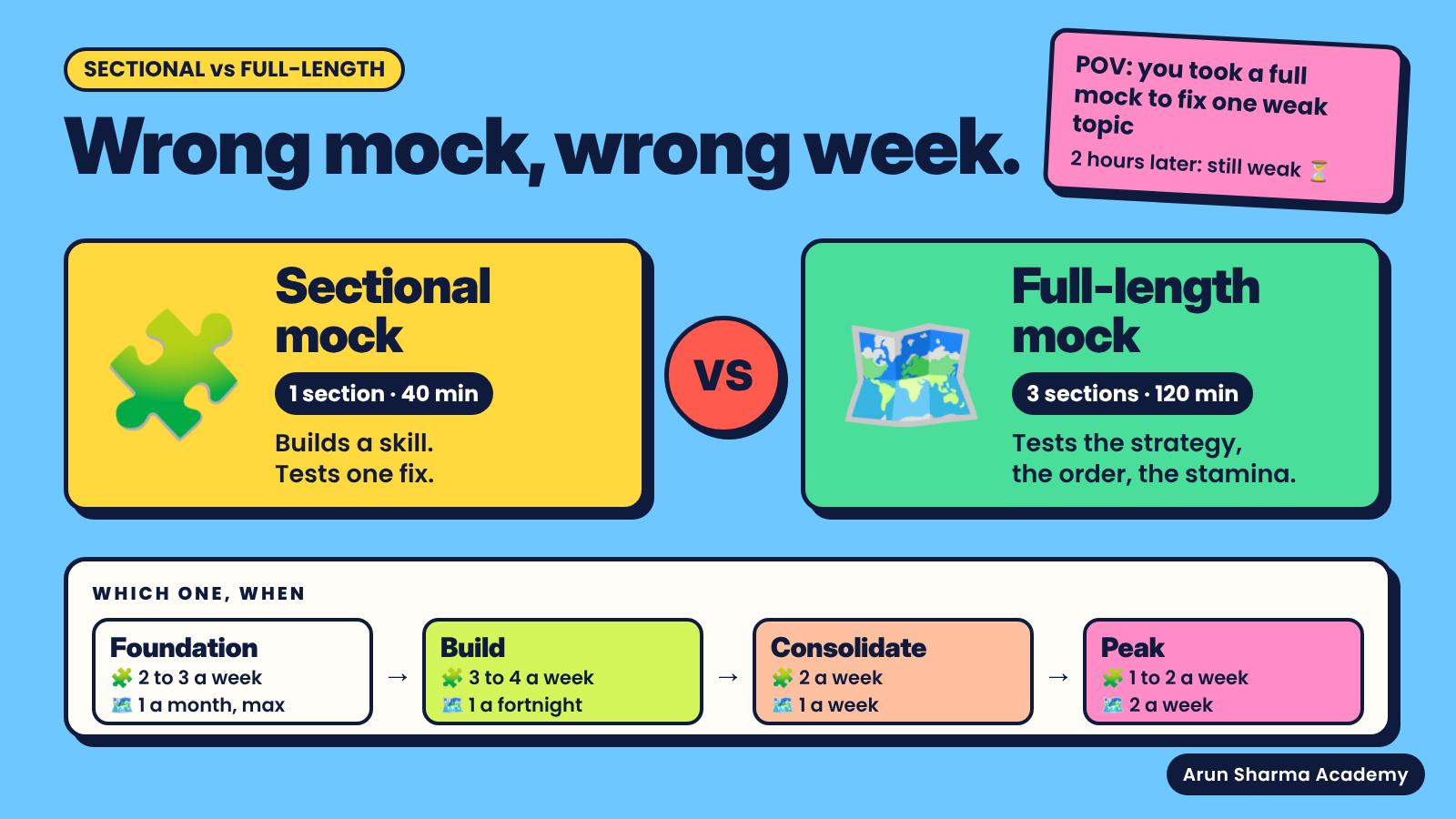
Here is a pattern that shows up every CAT season. A student's DILR scores are weak, so they take another full-length mock. Two hours later they know what they knew before: DILR is still weak. Along the way they have spent forty minutes on VARC and forty on QA that had nothing to do with the problem, and they now have a whole paper to analyse when the question was about one section.
Full-length mocks and sectional mocks look like the same tool in two sizes. They aren't. Each one answers a different question about your preparation, and most wasted mock weeks come from asking the right question of the wrong test.
Should you take sectional mocks or full-length mocks for CAT?
Both, at different stages. Take sectional mocks while you are still building a section, because they isolate one skill and give quick feedback. Move to regular full-length mocks once all three sections are workable, because only a full paper tests stamina, the fixed section order and how one bad section affects the next.
What a sectional mock actually measures
A sectional mock is one section under real conditions: forty minutes, one sitting, no pausing. That is exactly the time limit each section carries in CAT, so a sectional tells you something real about how you perform inside a section. It measures four things well:
- how much of a topic you can recall under time pressure
- the choices you make inside a section, such as which RC passage to read first or which DILR set to leave alone
- your accuracy when nobody is checking your work
- whether you can hold concentration for a full forty minutes on one kind of thinking
Its best use is testing a specific fix. Say you have changed the way you choose RC passages. A VARC sectional tests that change in forty minutes. A full mock would test it too, but it would cost you two hours and bury the answer under eighty minutes of unrelated data.
Make your sectionals feel like the real thing. Sit at a desk, not on the bed. Use only an on-screen calculator. Do your rough work on A5-sized sheets, because the scribble pad you get at the CAT centre is roughly A5, half an A4 page, and a DILR grid that fits easily on a notebook page can feel cramped on a pad that size. Past CAT papers make the best sectionals of all, since every question in them came from the real exam.
What only a full-length mock can show you
Some things stay invisible until all three sections sit back to back.
The fixed order. CAT runs its sections in a set sequence, which in recent years has been VARC, then DILR, then QA. You cannot switch between sections, and when a section's forty minutes are up it closes for good. A full mock is the only practice that makes you live with that order.
Carry-over. A rough DILR section doesn't stay in DILR. After abandoning a set, it is easy to start QA rushed and defensive, and to drop easy questions you would solve on a calmer day. You can only find out how much a bad section leaks into the next one, and practise stopping the leak, inside a full paper.
Your energy curve. Two hours of hard thinking feels different from forty minutes. If your accuracy falls away in the final section, which in CAT is QA, only full-length mocks will show it to you.
The paper as a whole. A question such as "Is my VARC target realistic if DILR goes badly?" only has an answer when all three sections sit on one scorecard.
The stage-to-mock map
The right mix depends on where you are in your preparation. Use this as a starting point and adjust it to what your own analysis shows.
| Stage | Where you are | Sectional mocks | Full-length mocks | What you are learning |
|---|---|---|---|---|
| Foundation | Still learning core topics | 2 to 3 a week, on topics you have finished | One diagnostic at the start, then one a month at most | What each section feels like under time |
| Build | Most topics covered once | 3 to 4 a week | One every two weeks | Where the gaps are, topic by topic |
| Consolidate | All three sections workable | 2 a week, aimed at your weakest section | One a week | Selection, attempts and section targets |
| Peak | The last six to eight weeks | 1 to 2 a week, weakest section only | Two a week, each fully analysed | Stamina, order and composure |
Two rules sit on top of the table. First, a full mock you can't analyse properly is worth less than a sectional you can. Second, the mocks stop a few days before the exam. Take your last full-length mock three or four days before CAT and keep the remaining days for light practice, revision and sleep.
How often is too often?
Over-mocking is a real failure mode, and it is easy to miss because taking a mock always feels productive. Watch for these signs:
- the next mock arrives before you have finished analysing the last one
- your scores swing up and down and you can't explain why
- you have stopped studying topics and only take tests
- you recognise questions or sets from earlier mocks in the same series
- the same mistakes keep appearing in your analysis week after week
- three or four mocks in a row land within a few marks of each other, with no change in method between them
If two or more of these sound familiar, cut your full mocks by half for two weeks and spend the hours on the topics your analysis keeps pointing to.
Analysis time is part of the mock
A useful rule of thumb is 1:2. For every hour of testing, plan two hours of analysis, done within a day or two while you still remember why you made each choice. A full-length mock therefore needs about four hours of analysis, which is easier to manage in two sittings. A forty-minute sectional needs about eighty minutes.
That sounds like a lot until you see what the time is for. Re-attempt the questions you got wrong or skipped, without looking at the solutions first. Then read the solutions. Then note the cause of each mistake and the time each question cost you, including the ones you got right slowly. In DILR, check whether your attempt plan held up. The worksheet in How Many DILR Sets Should You Attempt in CAT? turns your mock data into a target for the next mock.
If the 1:2 rule leaves you no time for topic study, you are taking too many mocks. Cut the number of mocks and keep the analysis.
FAQs
When should I take my first full-length mock? Early, as a diagnostic, once you know the exam pattern. It shows you what you are preparing for. After that, wait until most topics are covered before taking full mocks regularly.
Can sectional mocks replace full-length mocks? Not entirely. Sectionals can carry most of your practice, but you need a run of full mocks before the exam to rehearse the order, the stamina and the switch from one section to the next.
How many mocks should I take each week? It depends on your stage, as the table shows. Even in the final weeks, two full-length mocks a week is enough if each one is analysed properly.
Should I take sectionals in the final month? Yes, in small numbers, aimed at your weakest section. Stop all testing in the last few days so you reach the exam rested.
Every mock is only as useful as the decision it leads to. The CAT Experience test series gives you full-length mocks to run this schedule on, S.C.A.L.E. Combo gives you a structured route through all three sections for the sectional weeks, and the previous-year CAT papers remain the most honest sectionals you can take.