
Practising DILR Without a Coaching Institute: Where the Sets Come From and How to Use Them
Self-preparation in DILR usually stalls for a sourcing reason rather than a talent reason. Where to find usable sets, how many to do each week, and the review loop that makes them count.
By Shiva Guru N · 9 October 2026
Plenty of CAT students prepare without a coaching institute. Some can't afford one, some live far from any centre, and some are fitting preparation around a full-time job. If that is you, DILR is usually where self-study first gets hard. The first few weeks go well. You solve sets from a book or a free PDF and feel real progress. Then the good material runs out, and what is left is a folder of sets with unclear sources, uneven difficulty and the odd wrong answer key. At that point the problem is almost never your ability. It is the supply of good sets, and how quickly they get used up.
How do you practise DILR for CAT without coaching?
Use previous-year CAT papers as your base, add a graded set bank for volume, and avoid random PDFs of unknown origin. Solve each set, review it properly, then attempt it again a week later. The review does more for your score than the first attempt.
Past CAT papers as your base
Previous-year CAT papers are the best DILR practice material you can get, because they are the real thing. The difficulty is right and the style is right.
They are also limited, so ration them. A common mistake is to work through every past paper in the first two months and have nothing reliable left for the final stretch. Keep the most recent papers for timed practice closer to the exam, and use the older ones now for learning and practising set types. The previous-year CAT papers archive makes that split easy to plan.
For volume beyond the papers, use a set bank where the sets are graded by difficulty and every solution is worked step by step. A set without a worked solution only tells you whether you were right. A set with one shows you how you should have got there.
Books, and the order to work through set types
A good book gives you something past papers can't: sets grouped by type and graded by difficulty. If you are using Arun Sharma's CAT books, the separate data interpretation and logical reasoning titles make a solid base alongside past papers.
Order matters as well. Start with the types that build basic habits: arrangements, distributions and simple tables. Move on to scheduling and tournaments once grids feel natural. Leave networks and mixed sets that combine DI and LR until you can recognise the simpler types quickly. Our guide to CAT DILR set types explains how to spot each one.
A rough twelve-week shape for preparing on your own:
- Weeks 1 to 4: one set type at a time, untimed at first, with full reviews.
- Weeks 5 to 8: mixed sets, timed, with the weekly re-attempt loop below.
- Weeks 9 to 12: timed sectionals and the recent past papers you saved, with set selection practice.
The review loop that does the real work
Most students solve a set, check the answers and move on. That throws away most of what the set could teach.
Try this instead. Solve the set with a timer running. Before looking at the solution, go back to whatever you got wrong or skipped and try it again without the timer. Only then read the solution, and note exactly where you got stuck: the clue you misread, the case you never considered, the moment a grid would have saved you. A week later, attempt the same set again under time. If it opens quickly now, the lesson stuck. If it still resists, it goes back into the queue.
This loop feels slower than racing through new sets. Over a month, it is the part that actually moves your accuracy.
How much practice is enough each week
There is no universal number, and anyone giving you one without knowing your schedule is guessing. Here is a sensible starting point.
If you are working and have an hour or so on weekdays, you can usually manage one set a day with a proper review, plus a timed block of three or four sets at the weekend. That comes to roughly nine to eleven sets a week, each one reviewed.
If you are preparing full time, you can double that, but only if the reviews keep up. Twenty sets solved and reviewed will do more than forty solved and forgotten.
Whatever your volume, watch one figure: how many sets you re-attempted this week. If the answer is zero, you are only practising first attempts.
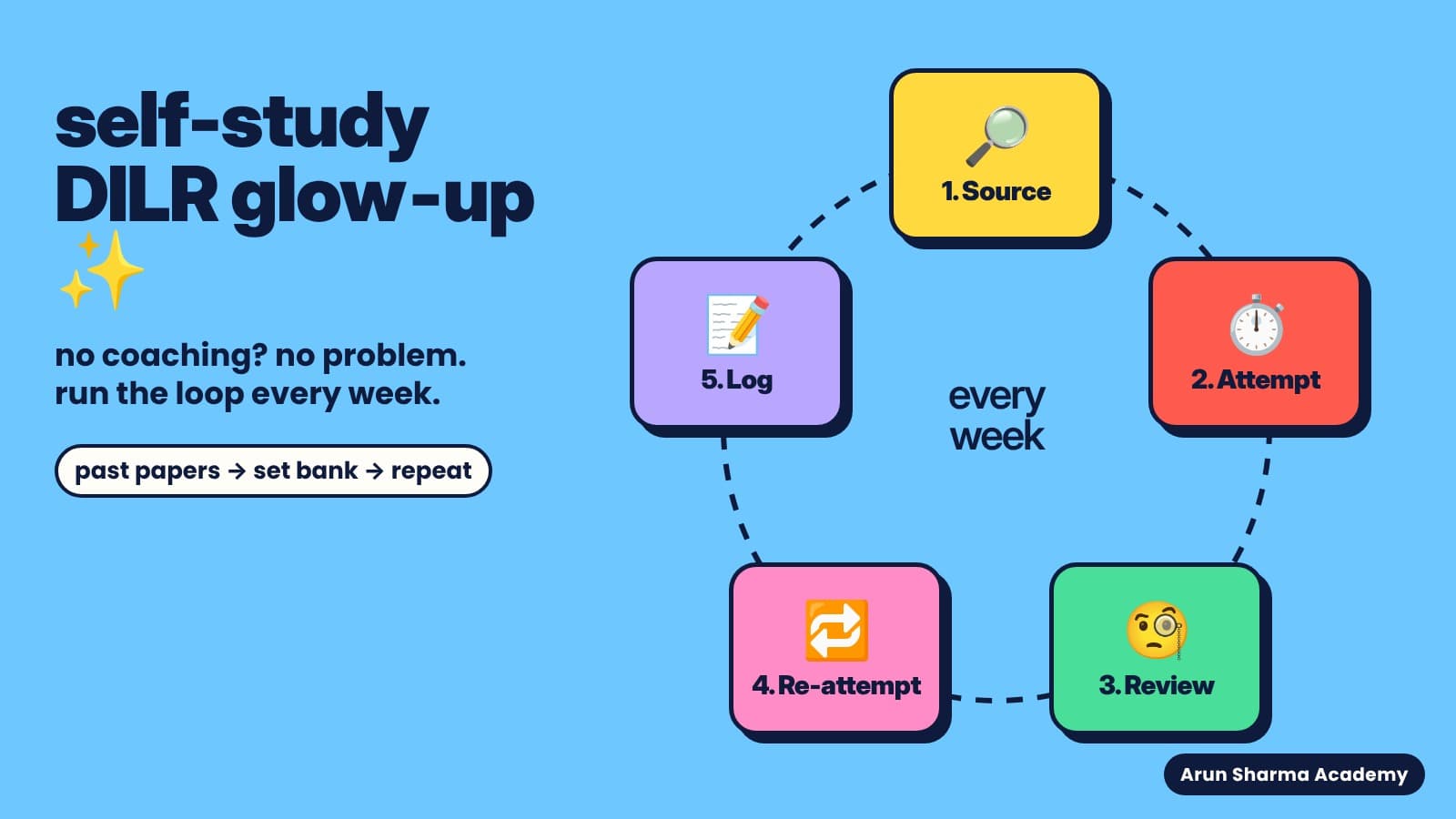
The weekly practice loop
- Source. Pick the week's sets in advance from past papers and your set bank, mixing types.
- Attempt. Solve each set timed, as you would in the exam.
- Review. Re-attempt untimed before reading the solution, then note where you got stuck.
- Re-attempt. Redo last week's two or three weakest sets under time.
- Log. Record the set type, the time taken and the reason you got stuck, so patterns show up.
What self-study genuinely can't give you
Two things are hard to get on your own, and it is better to know them now than to discover them in November.
The first is a sense of where you stand. Practising alone, you have no way of knowing whether eleven minutes on a set is fast or slow compared with the people you will actually compete against. A percentile from a mock taken by a large group tells you that. Nothing in a solo routine does.
The second is feedback on your method. A solution gives you the answer and one route to it. It won't tell you that your way of setting up the grid cost you three minutes. A mentor or a structured course can spot that in a single session.
Neither gap needs a full coaching programme. A mock series closes the first. A course that shows worked approaches closes much of the second.
FAQs
How many DILR sets should I do per day? One set with a full review is a solid daily baseline for most working students. Add more only if the reviews keep up.
Is solving DILR in a study group useful? For review, yes. Comparing how two people cracked the same set is one of the quickest ways to pick up new approaches. For timed practice, work alone.
When is a paid set bank worth buying? Once you have used up the past papers set aside for learning and your free sources have become unreliable. Graded difficulty and worked solutions are what you are paying for.
Preparing on your own takes discipline, and it works for a great many students. Start with the previous-year CAT papers already open to you, and move to DILR 100 when you need more graded sets with the reasoning laid out.