
How to Build a CAT Error Log You Will Actually Open Again
Most error logs die within weeks because they record what went wrong instead of why. A five-column format, nine cause tags and a revisit rule that lasts the whole season.
By Shiva Guru N · 12 November 2026
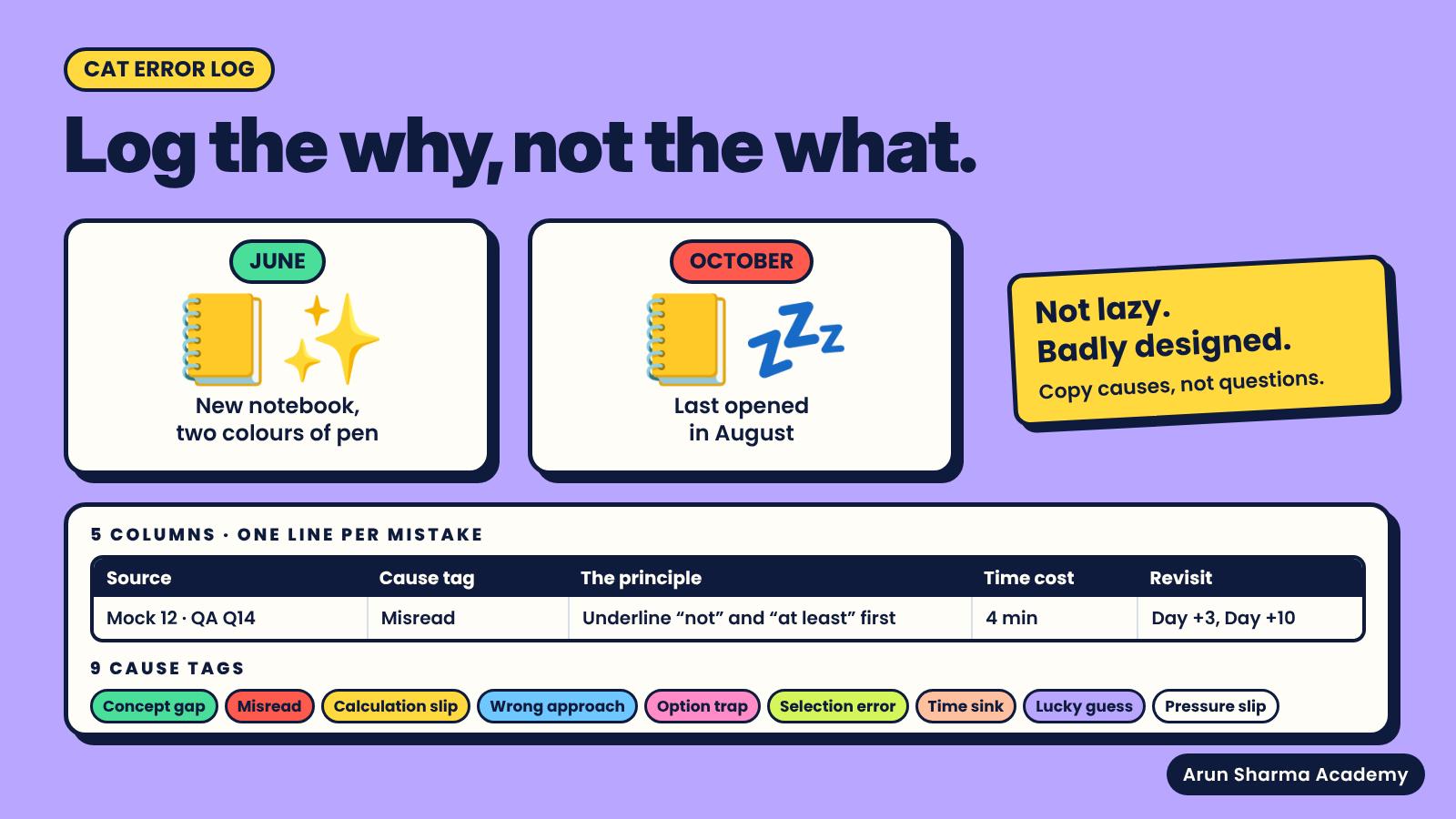
Almost every CAT aspirant starts an error log. It usually begins in a new notebook, with neat headings and two colours of pen. For a few weeks it grows beautifully. Then a heavy mock week arrives, the notebook falls behind, and by October it sits under a pile of printouts, last opened in August.
The usual explanation is a lack of discipline. The real problem is usually the design. Most logs record the question: the full problem, copied out, with the solution underneath. That is slow to write and dull to read, so the log stops being written and then stops being read. A log that records the cause of each mistake takes seconds per line to fill in, and it grows more useful the longer you keep it.
What should a CAT error log record?
Record the cause of each mistake, not the question. For every error, note where it came from, a cause tag from a fixed list, the principle that would have prevented it, the time it cost, and a date to try it again. That is five fields and one line per mistake.
Why logs that copy questions stop working
Copying is expensive. Writing out a DILR set with its table can take ten minutes. After a full mock with fifteen or twenty mistakes, nobody has that kind of time, so the log falls behind within a fortnight.
Re-reading is comfortable, and comfort can mislead you. When you look at a solved question again, it feels familiar, and familiarity feels like learning. Recognising a solution you have already seen is far easier than producing one cold under time pressure, which is what CAT asks of you.
A pile of copied questions also hides the pattern. Two hundred copied questions won't tell you that sixty of them went wrong because you misread what was being asked. A cause tag on every line tells you that in a minute.
Timing matters too. Memory research going back to Hermann Ebbinghaus in the 1880s shows that forgetting is steepest soon after you learn something, and that reviews spread out over time hold better than one long session of re-reading. An error log works with that fact only when it has revisit dates built in.
The five columns
1. Source. Just enough to find the question again, such as "Mock 12, QA, Q14" or "CAT 2023 Slot 2, DILR Set 3". Never copy the question itself.
2. Cause tag. One tag from the fixed list of nine below. One tag per mistake, chosen honestly.
3. The principle. One sentence you would want to say to yourself before the next similar question. "In questions that ask for 'at least', check the complement first." "Read the last line of an RC question before going back to the passage." If you can't write the principle, you haven't finished understanding the mistake.
4. Time cost. The minutes the question took, written as a number. This column catches a kind of error most logs miss completely: the question you got right in six minutes when it deserved two.
5. Revisit date. The day you will solve the question again, cold, without looking at your principle first.
Log more than wrong answers. Add the questions you got right by guessing, and the ones you got right far too slowly. A lucky right answer is a mistake that simply hasn't happened yet, and the exam is a bad place for it to happen.
Nine cause tags, and why the list must be fixed
Free-text notes such as "silly mistake" or "need more practice" feel honest, but you can't count them. A fixed vocabulary can be counted. Use these nine tags and no others:
- Concept gap: you didn't know the idea or the formula.
- Misread: you answered a different question from the one asked, missing a "not", an "at least" or a unit.
- Calculation slip: the method was right and the arithmetic went wrong.
- Wrong approach: your method was valid but too slow to finish in time.
- Option trap: in VARC, you chose an option built to mislead, such as one that is too broad, or true but off the point. Para Summary Questions in CAT covers the main trap types.
- Selection error: you attempted a question or a DILR set you should have left for later.
- Time sink: right or wrong, it cost far more time than it was worth.
- Lucky guess: the answer was right and the reasoning wasn't.
- Pressure slip: a mistake that happened because of the state you were in, late in a section or straight after a bad set.
After three mocks, count the tags. A tally such as "Misread 11, Concept gap 4, Time sink 7" changes your plan. It tells you that more theory won't help much, and that reading the last line of each question twice and setting a time limit per question will.
The copy-ready template
Set the log up as a table or a spreadsheet with these five columns. The sample rows show the level of detail to aim for. Each line takes under a minute to write.
| Source | Cause tag | The principle | Time cost | Revisit on |
|---|---|---|---|---|
| Mock 12, QA, Q14 | Misread | Underline "not" and "at least" on the scribble pad before solving | 4 min | Day +3, then Day +10 |
| Mock 12, DILR, Set 3 | Selection error | If the first constraint places nothing within two minutes, move to the next set | 11 min | Day +3, then Day +10 |
| Mock 12, VARC, RC 2, Q3 | Option trap | Reject options that are true in the passage but don't answer the question asked | 3 min | Day +3, then Day +10 |
If you use a spreadsheet, put the nine tags in a dropdown so you can't drift back into free text. Counting them then takes a single filter.
The revisit rule
A log that is only ever written helps nobody. Three habits keep it alive.
Re-solve on a schedule. Solve each logged question again cold, three days after the mistake and again about ten days after that. If you get it right both times, quickly and for the right reason, mark it closed. If you miss it again, give it a new date and check whether you chose the right cause tag in the first place.
Count every week. Spend twenty minutes at the end of each week tallying the tags. The tag at the top decides your focus for the next week. That one habit turns the log from a record into a plan.
Prune every month. Read through everything still open, and archive the closed lines. If open entries pile up faster than you can revisit them in a week, you are logging too much. Keep logging every wrong answer, but stop logging slow-but-right questions that cost less than two minutes.
In the last two weeks before CAT, stop adding entries and read only the principle column for your top two or three tags. Those few sentences become your personal rules for exam day.
FAQs
Paper notebook or spreadsheet? Either works. A spreadsheet makes counting tags and sorting by revisit date much faster. A notebook is fine if you tally the tags by hand every week.
How many entries should one mock produce? Every wrong answer, plus the lucky and slow ones. For a full-length mock that often comes to somewhere between ten and twenty lines. If it is far more, log the costliest mistakes first.
My log is already huge and I never read it. What now? Archive it and start again from your last two mocks, using the five columns and the nine tags. A short log you open every week is worth more than a long one you avoid.
Should I log questions I skipped? Only the ones you could have solved, which you discover when you re-attempt them during analysis. Those are selection errors, and they are often the cheapest marks to win back.
Every mock you take should feed this log, and every week the log should change what you practise. The CAT Experience test series gives you full-length mocks to fill it from, Sectional Mocks vs Full-Length Mocks explains when to use each kind of test, and the previous-year CAT papers give you real questions to re-solve on revisit day.