
Para Summary Questions in CAT: How to Spot the Trap Option
Wrong options in para summary questions fail in predictable ways. The four main traps, two quieter ones, and the order of elimination that saves time.
By Shiva Guru N · 17 October 2026
Para summary questions have a way of catching careful students. You read the paragraph slowly, notice every detail, and then pick the option that captures the most detail, which turns out to be wrong. It happens because the wrong options aren't random. They are written to:
- look thorough
- sound sensible
- repeat something the paragraph really said
Once you know the handful of ways a wrong option is built, these questions become far less stressful.
What makes a correct para summary answer?
The right option carries the author's main argument, not the supporting details, and matches its scope and strength exactly.
| The correct option is... | ...no more and no less than the paragraph |
|---|---|
| Not narrower | It covers the whole argument, not one step of it |
| Not broader | It stays inside the paragraph's topic |
| Not more certain | It keeps the author's qualifiers |
| Not less certain | It doesn't soften a firm claim |
Eliminate on scope first, then argument, then tone.
A paragraph to work with
Every example below uses this paragraph.
Cities often respond to traffic congestion by building more roads. For a while, journeys get faster. But faster journeys attract people who previously avoided driving at peak hours, took the train, or did not make the trip at all. Within a few years the new lanes fill up, and congestion returns to roughly where it began. Transport researchers call this induced demand. Roads are not useless, but adding capacity alone cannot be relied on to cure congestion, because the supply of road space itself shapes how much people choose to drive.
The four main traps
| Trap | Example option | Why it's wrong | Question to ask |
|---|---|---|---|
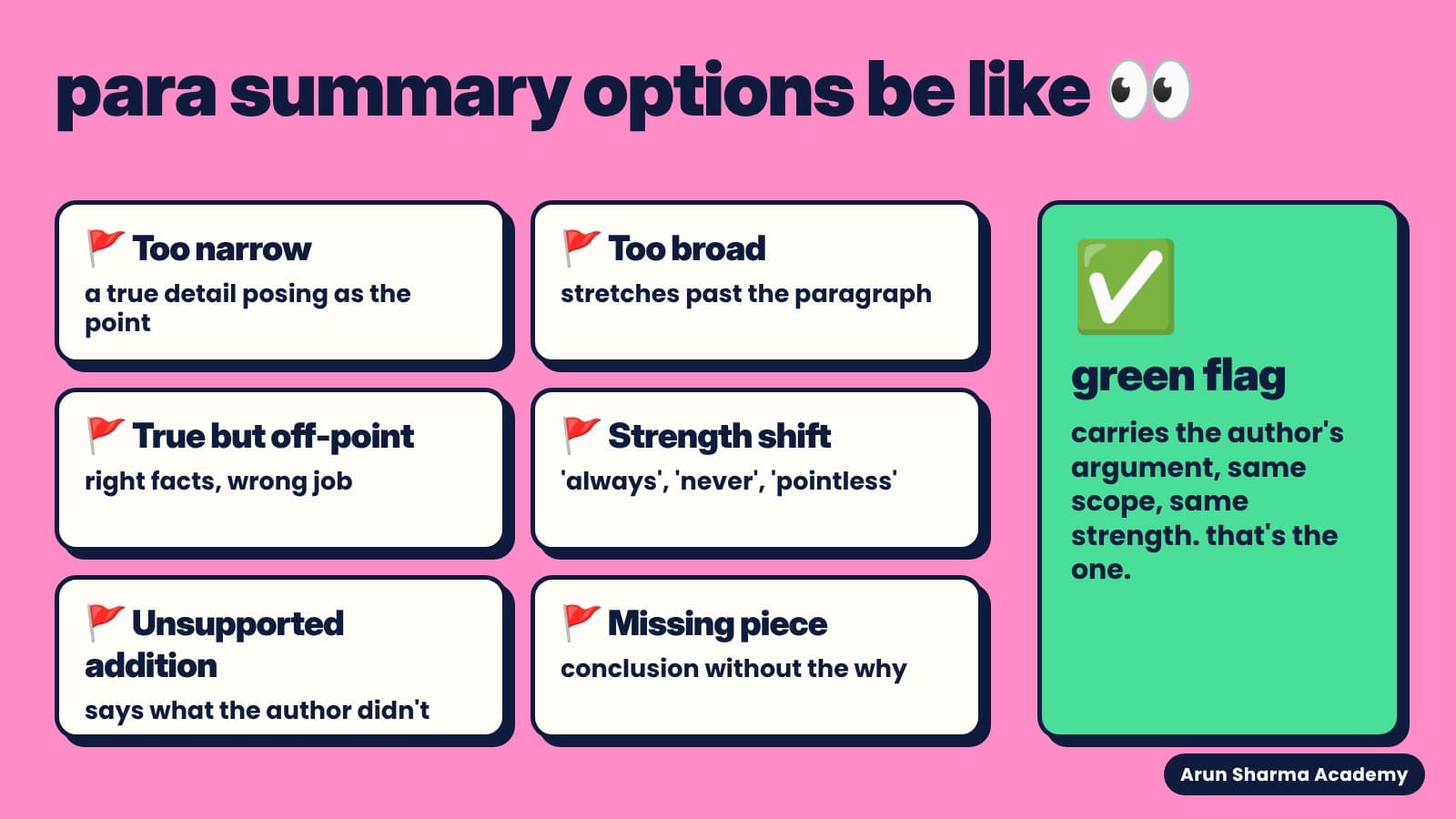
| Too narrow | "New road lanes usually fill up within a few years of being built." | The paragraph says this, but it is one step in the argument, not the argument | Is the author trying to convince me of this, or just mentioning it on the way? |
| Too broad | "Government infrastructure spending rarely achieves what it promises." | Stretches a point about roads and congestion into a claim about all infrastructure | Does the paragraph really cover that much ground? |
| True but off-point | "Faster journeys after a new road opens draw people away from trains." | Every word is supported, but it describes how the effect works, not what the author concludes | It passes "is it true?" Does it pass "is it the point?" |
| Strength shift | "Building roads is pointless, because congestion always returns to its original level." | The paragraph says roads are "not useless" and congestion returns "roughly" to where it began | Have the qualifiers changed? |
A few notes on these four:
- Too narrow options tempt you because they are clearly true and easy to check.
- Too broad options tempt you because they sound wise.
- True but off-point and strength shift are the hardest, because they survive a quick check.
- With a strength shift, watch for words like always, never, only and pointless when the paragraph was more cautious. The option has turned a careful claim into a sweeping one, and being close to the argument is exactly what makes it dangerous.
The correct summary
"Expanding road capacity tends to attract extra driving that eats up the gains, so it can't by itself be counted on to solve congestion."
Why it works:
- It carries the conclusion.
- It keeps the scope to roads and congestion.
- It matches the paragraph's caution.
In the exam you will see four options, not five. The traps are the same.
Two quieter traps
Two more kinds of wrong option turn up often enough to name.
| Trap | Example option | Why it's wrong |
|---|---|---|
| Unsupported addition | "Cities should stop building roads and invest in public transport instead." | The paragraph never recommends anything. The option adds an idea the author didn't state, however sensible it sounds |
| Missing piece | "New roads don't cure congestion in the long run." | The conclusion is there, but the reason has gone: the extra driving that new roads attract. A summary that drops the author's reason has dropped half the argument |
The elimination order that works
| Step | Check | What it removes |
|---|---|---|
| 1. Scope | Is it narrower or broader than the paragraph? | Often one or two options, quickly |
| 2. Argument | Does it state the author's conclusion, not a step or a detail? | Off-point and narrow survivors |
| 3. Tone and strength | Does its certainty match the paragraph's? | Overstated options. A single "always" can sink one |
The one thing not to do first:
- Don't pick the option that reads most smoothly. Wrong options are often written more fluently than the right one.
The trap card
Keep this beside your practice sets.
| Trap | What it looks like | The test |
|---|---|---|
| Too narrow | A true detail presented as the whole | Is this the point, or a step? |
| Too broad | The topic stretched beyond the paragraph | Does the paragraph cover this much? |
| True but off-point | Supported, but describes how something works rather than the conclusion | Would the author call this their main claim? |
| Strength shift | The right idea stated with more or less certainty | Compare the qualifiers word for word |
| Unsupported addition | An idea the author never stated | Can you point to where the paragraph says this? |
| Missing piece | The conclusion without its reason | Does the option say why, as the paragraph does? |
Odd sentence out, briefly
Odd-sentence-out questions give you five sentences. Four form a paragraph and one doesn't belong. The same scope thinking helps.
The odd sentence is usually one of these:
- on a nearby topic, but outside the paragraph's scope
- on the right topic, but unable to link to the others
How to find it:
- Use the pair-finding approach from our parajumbles guide.
- Find the four sentences that link.
- See which one is left without a partner.
In CAT 2025 these were Type In The Answer questions, so a wrong attempt cost only the time it took.
FAQs
How long should a para summary question take? Around two minutes, a little more for a dense paragraph. Most of that time should go on reading the paragraph, not the options.
Should I attempt every summary question? In CAT 2025 summary questions were multiple choice, so a wrong answer cost a mark.
- Attempt when scope and argument have narrowed it to one option.
- If two survive and you can't separate them, leaving it is a reasonable choice.
Why do I keep choosing the second-best option? Usually because of the strength shift. You find the right idea and miss the qualifier. Make the tone check a fixed last step, even when you feel sure.
Summary questions reward a habit more than a talent: reading for the argument and checking scope before anything else.
- VARC 250 gives you the practice to make that habit automatic.
- S.C.A.L.E. VARC connects it with reading comprehension, where the same skill earns most of the section's marks.