
How Many DILR Sets Should You Attempt in CAT?
Attempt count is the wrong first question. How accuracy, set difficulty and your own time per set decide the number, and how to work yours out from mock data.
By Shiva Guru N · 9 October 2026
Ask ten people how many DILR sets you should attempt in CAT and you will get ten confident answers. Two. Two and a half. Three, if the paper is kind. When the section already makes you nervous, it is tempting to grab one of those numbers and hold on to it. The trouble is that each one came from someone else's accuracy, speed and slot. It may be exactly right for them. Your number has to come from your own mocks, and this article shows you how to work it out in about half an hour.
How many DILR sets should you attempt in CAT?
The right number depends on three things: your accuracy on the sets you choose, the time you need per set, and how hard your slot turns out to be. Work out the first two from recent mocks. Adjust for the third on the day.
Why two students with the same attempts score very differently
Take two students who both attempt three sets. The first solves all three completely and gets nearly everything right. The second rushes the third set, gets half of it wrong, and loses marks to negative marking on the multiple-choice questions. On paper they attempted the same amount. On the scorecard they are far apart, and accuracy is the whole difference.
One set finished cleanly is worth far more than a set and a half guessed through, and the marking scheme punishes the guessing. So the useful question before any exam is how many sets you can attempt at high accuracy in forty minutes. The attempt count follows from that.
Working out your own number from mock data
Take your last five full mocks or DILR sectionals. For every set you attempted, write down three things: minutes spent, questions attempted, questions correct.
From those, work out two figures. First, your average time for a set you solved fully. Second, your accuracy on the sets you picked, which is correct answers divided by attempts.
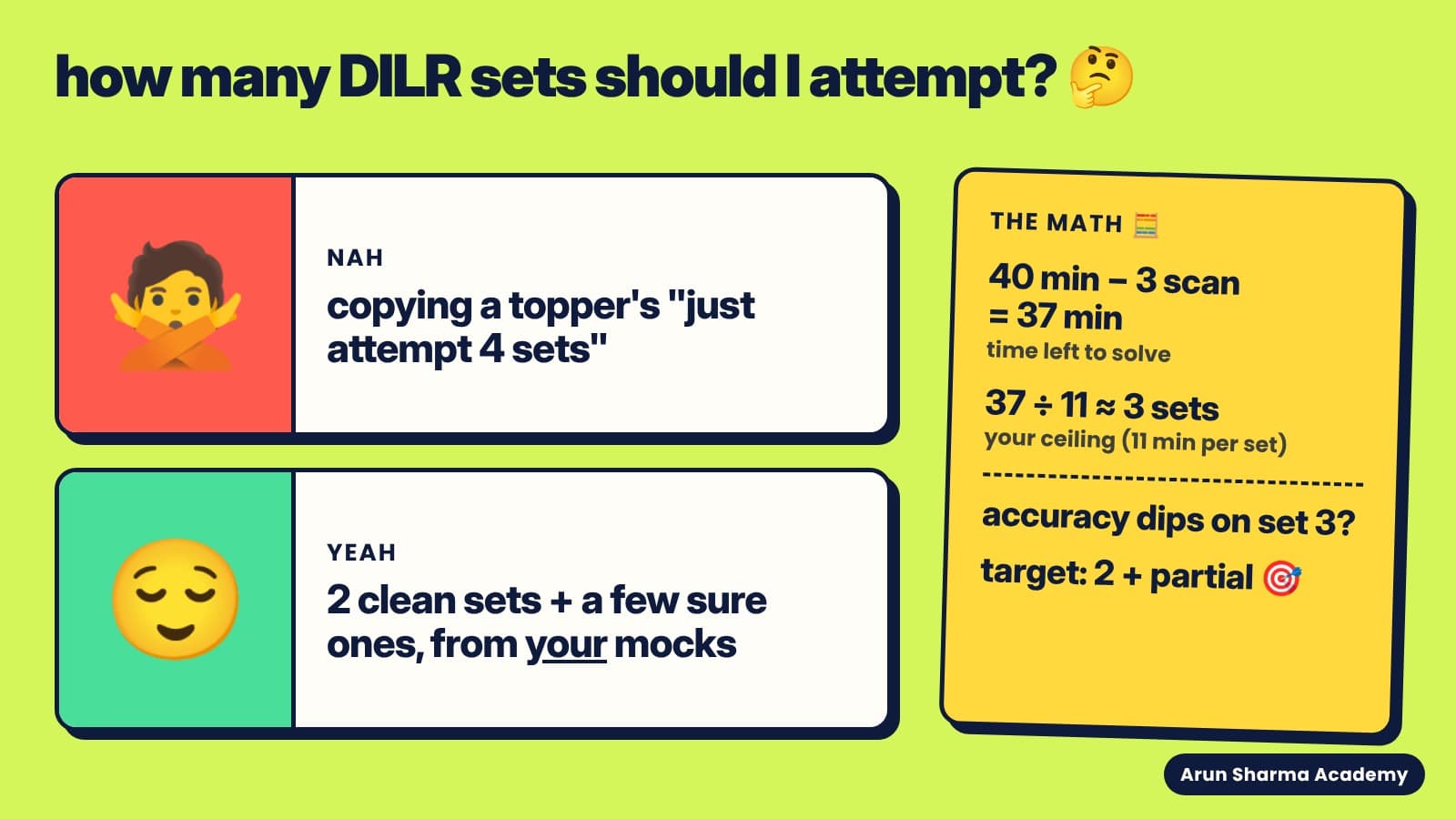
Now treat the section as a budget. You have forty minutes. Take away two or three for scanning the sets at the start, which you should be doing anyway. Divide what is left by your average time per fully solved set. That gives your realistic ceiling.
Then check that ceiling against your accuracy. If your accuracy holds up across all the sets you attempted, the ceiling is your target. If it drops sharply on the last set in most mocks, your real target is one set lower, with the spare minutes spent making the others clean. More sets at lower accuracy usually score worse than fewer sets done properly.
Difficulty and normalisation, stated carefully
Two honest points, because this is where a lot of confident advice goes beyond what anyone actually knows.
DILR difficulty varies between slots and between years. A set that takes ten minutes in one slot may have a counterpart elsewhere that takes fifteen. Your target has to bend with the paper in front of you.
Scores across slots are also normalised. The IIMs explain the process on the official CAT website, and it exists so that a harder slot doesn't count against you. What nobody outside the process can tell you is the exact raw score that will produce a given percentile in your slot. Anyone quoting that figure before results is estimating. Read the official explanation, then plan around your accuracy, which is the part you control.
What scores have looked like, as estimates
Everyone wants a number, so here is the honest version. After CAT 2025, published estimates from coaching analyses put a 99 percentile in DILR at roughly 30 marks and a 90 percentile at roughly 17. These are not official figures, and they move from year to year and slot to slot.
Turned into questions, they look far less frightening. At three marks for each correct answer, 30 marks is about 10 correct answers with no wrong ones, and 17 marks is about six. In a section of 22 questions across roughly five sets, that means two sets solved cleanly, plus a few sure answers from a third, has been enough for a very high percentile on these estimates. Three or four sets attempted carelessly often isn't.
Choosing which sets to attempt
Spend the first two or three minutes scanning every set before solving any.
Lean towards sets with clear, complete rules, a small number of people or items, and questions that open up once the core arrangement is fixed. Be careful with sets that make you track many separate cases, rules that are long and full of conditions, or tables where most of the values are missing. A set that looks familiar in the first minute is usually the right place to start.
The attempt worksheet
Fill this in from your own mocks. The example shows a student who averages 11 minutes per fully solved set.
- Section time: 40 minutes
- Scanning time at the start: 3 minutes
- Time left for solving: 37 minutes
- Average time per fully solved set: 11 minutes (from the last five mocks)
- Ceiling: 37 divided by 11 gives 3 sets, with about 4 minutes spare
- Accuracy check: strong on the first two sets, drops on the third in three of five mocks
- Working target: 2 sets fully solved, plus a partial third where only the confident questions get attempted
Your numbers will look different, and they should. The worksheet is useful precisely because it is built from your own mocks.
When the section turns out harder than expected
Sometimes the first scan shows no set that looks friendly. Your heart rate goes up, and the plan you made starts to feel useless. This is the moment most DILR scores are lost, because students either freeze or attack whatever set they see first.
Have a rule ready before exam day. If a set hasn't opened up after about four minutes, meaning you still have no fixed starting point, leave it and move to the next one. Partial sets are allowed and often sensible. Two or three sure answers from a set you couldn't finish still count. TITA questions carry no negative marking either, which makes a careful attempt at one cheaper than a guess on a multiple-choice question.
Remember that a harder paper is harder for everyone in your slot, and normalisation exists for exactly that. Protect your accuracy. The number you planned for an easier paper no longer applies, and letting it go is the right call.
FAQs
Is there a minimum number of sets to attempt? No single minimum works for everyone. A clean attempt at fewer sets often beats a messy attempt at more. Your own mock data sets your floor.
Should I attempt partial sets? Yes, when some questions in the set can be answered on their own or after one small step. Take the sure ones and move on.
Should I guess TITA questions in DILR? TITA questions carry no negative marking, so a reasoned attempt costs only time. A blind guess at a typed answer almost never lands, though, so spend the minutes where you have a real chance.
Can I change my attempt plan in the middle of the exam? You should, if the paper demands it. Decide your adjustment rule in advance so the decision takes seconds on the day.
Your attempt number is only as good as the mocks behind it. The CAT Experience test series gives you full-length mocks to build it from, and S.C.A.L.E. DILR works on the accuracy that number depends on.