
CAT DILR Set Types: How to Recognise Each One in the First Minute
Most CAT DILR sets are built on a handful of recurring structures dressed in new stories. How to name the type inside the first minute and choose the opening move that fits it.
By Shiva Guru N · 8 October 2026
Every year, students walk out of CAT saying the same thing about DILR: nothing in it looked like anything they had practised. If you have felt that in a mock, you know how unsettling it is to stare at a set about a tournament or boxes on shelves and have no idea where to begin. Here is the reassuring part. The story on top changes every year, but the structure underneath is usually familiar. CAT DILR sets fall into a small number of types, few enough to learn by name. Once you can name a set in the first minute, you know your first move, and that is often enough to steady you.
What types of sets appear in CAT DILR?
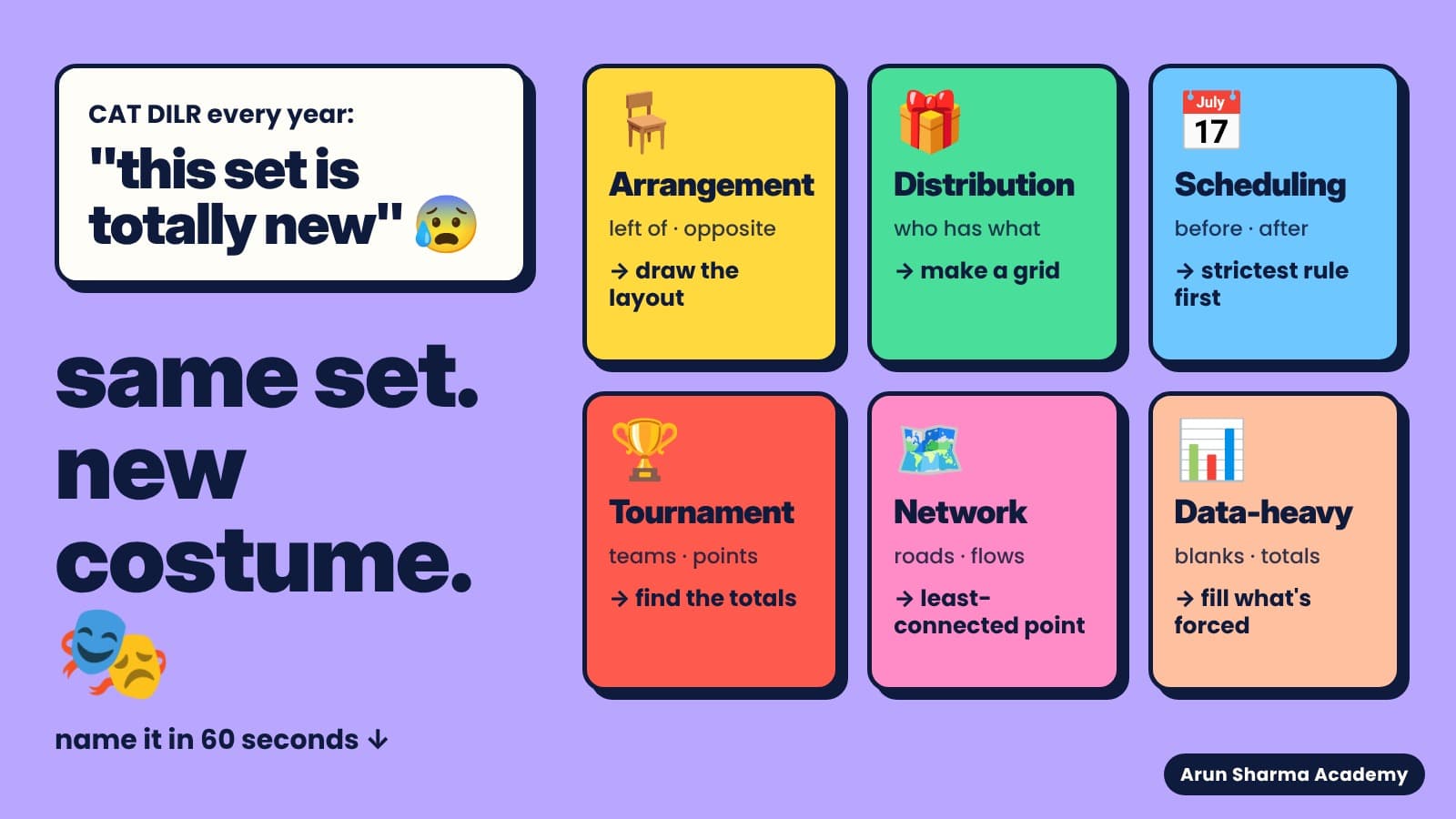
Most sets fall into five families: arrangement, distribution, scheduling and tournaments, routes and networks, and data-heavy sets that behave like DI. The story changes each year. The structure underneath rarely does, and each structure has a standard opening move.
In CAT 2024 and CAT 2025, the section had 22 questions per slot, spread across about five sets of four or five questions each, according to published analyses of those papers. That is a lot of reading for forty minutes, which is exactly why naming the type quickly matters.
Arrangement and distribution sets
Arrangement sets ask where things sit. People around a table, boxes on shelves, flats on floors, cars in a line. The signal is positional language: left of, immediately above, opposite, next to, between. When you see it, draw the layout before reading a single clue. A circle with numbered seats. A column of floors. Then place the fixed facts first, the clues that pin one person to one spot, and leave the relative clues for later.
Distribution sets ask who has what. Students and subjects, employees and departments, friends and the gifts they bought. The signal is a set of categories that have to be matched, often with counts: each person owns two, no two share a colour. The move here is a grid, people down one side and attributes across the top, filled with ticks and crosses. If you try to hold a distribution set in your head, or in scattered notes, it usually slips away by the third clue.
Plenty of sets combine the two. Six people on three floors, each with a different job, is arrangement and distribution together. Draw the layout for the arrangement and attach the attributes to it.
Scheduling, tournaments and network sets
Scheduling sets ask when things happen. Meetings across a week, exams across slots, tasks in a fixed order. The signal is time plus conditions: must happen before, can't fall on consecutive days, takes two slots. List the conditions from strictest to loosest and apply the strictest first. A clue that allows only one possibility goes in before a clue that allows three.
Tournament sets are a close cousin. Teams play each other, points are awarded, and the questions ask about final standings. The format is almost always stated at the start, and it is the key to the whole set. Work out how many matches were played and how many points were handed out in total before touching individual results. Totals rule out more cases than any single clue.
Route and network sets ask how things move. Cities joined by roads, water through pipes, messages passed between people. Draw the network, label each link with whatever is given (distance, cost, capacity) and start with the points that have the fewest connections. They allow the fewest options, so the answer usually starts to show there. Networks are also where many students get stuck, simply because they feel strange until you have drawn ten of them.
Data-heavy sets that look like DI
Some sets arrive as a table or chart and look like pure calculation. Often they are reasoning sets that use numbers as raw material. Missing values to be worked out from row and column totals. A chart of ratings where the question asks which combinations are even possible.
Read the table before the questions. Know what each row and column stands for, which cells are blank and which totals are given. Then read the questions to see what they actually need. Many of these sets turn on one early step, a single blank filled from a total, that opens up half the questions at once.
The 60-second recognition card
Keep this beside your practice sets until you no longer need it.
Arrangement. Signal: positional words such as left of, opposite, above. First move: draw the physical layout and place the fixed clues. Time cost: usually moderate.
Distribution. Signal: categories to be matched, counts per person. First move: a grid of people against attributes. Time cost: moderate, rising with every extra attribute.
Scheduling. Signal: days, slots, before and after. First move: rank the conditions by strictness and apply the strictest first. Time cost: moderate to high.
Tournament. Signal: teams, matches, points. First move: total matches and total points before any individual result. Time cost: high if you skip the totals.
Network. Signal: cities, roads, connections, flows. First move: draw the network and start at the least connected point. Time cost: high until the type feels familiar.
Data-heavy reasoning. Signal: a table with blanks or totals. First move: fill whatever the totals force. Time cost: low to moderate once the first step lands.
The time costs are a rough guide. Your own timings will serve you better, so replace them as you collect them.
Why recognising the type matters more than solving fast
Most students try to improve at DILR by solving faster. The bigger gain comes earlier. With forty minutes for the whole section, the costliest mistake is picking the wrong set and spending twelve minutes on it before realising it won't open. Recognising the type helps you choose. If you can name the set and see the first move within a minute, you can judge whether it suits you before you commit. And if you can't name it after a minute, that is useful information too. That set is often the one to leave for last.
FAQs
Can the set types in CAT be predicted? The families come back. The exact story and the twist inside it don't. Prepare by type, and expect every set to feel slightly new on the day.
How many sets do I need to practise before the types become obvious? There is no fixed number. When you can name the type of a fresh set within a minute on most attempts, you have done enough of that type. Track it and move on.
What if a set matches no type at all? It happens, though less often than it feels in the moment. Find the closest family and borrow its first move. If nothing fits after a minute, park it and come back once the familiar sets are done.
Naming a set type quickly comes from meeting each type many times. DILR 100 gives you that volume, and S.C.A.L.E. DILR takes you through each family in a planned order.