
CAT Parajumbles: The Link-First Method That Beats Guessing
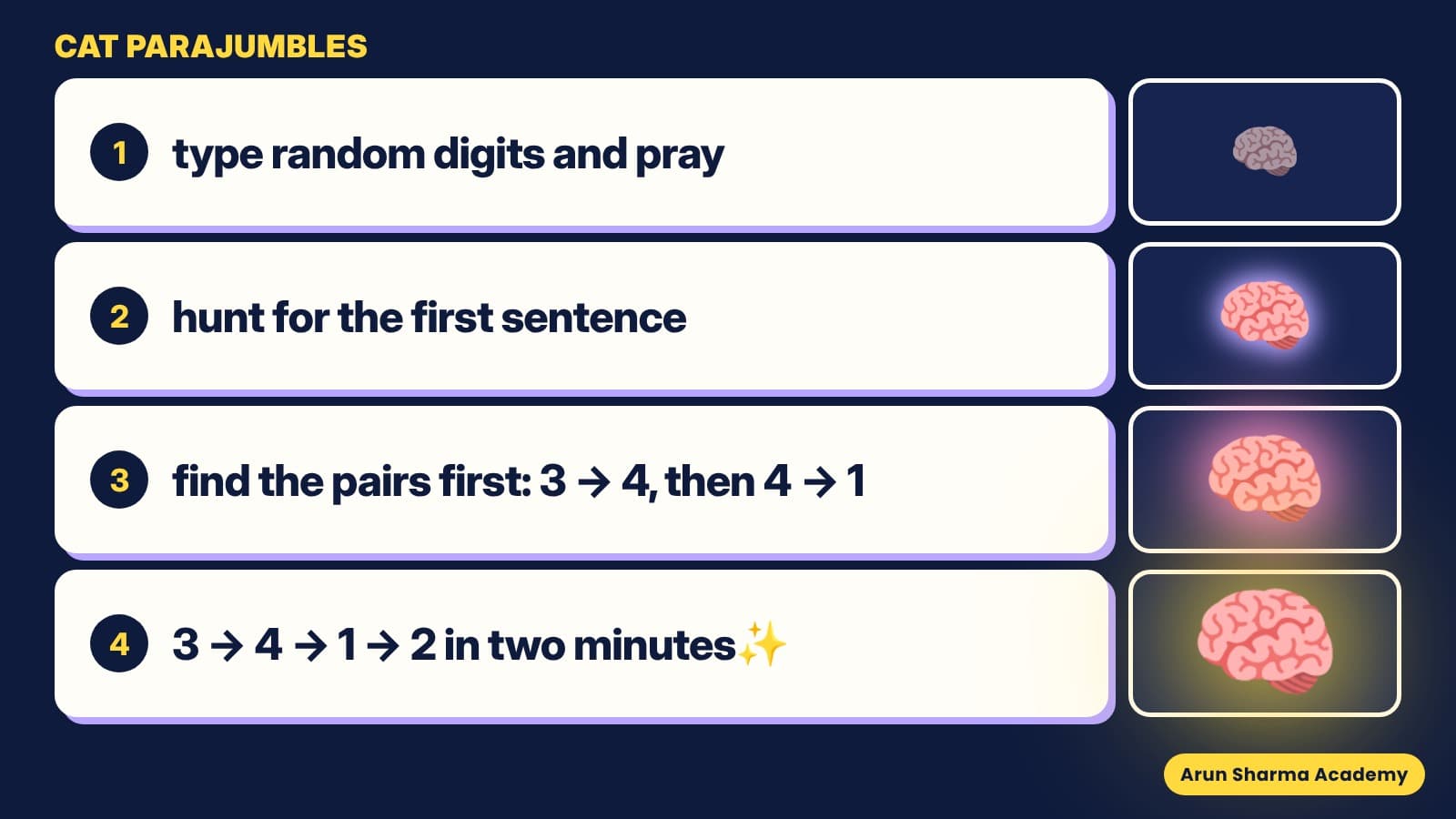
Hunting for the opening sentence is the slowest way to solve a parajumble. A link-first method that builds the order from sentence pairs, with a fully worked example.
By Shiva Guru N · 17 October 2026
Most students are taught to solve parajumbles by finding the first sentence. It sounds logical. In practice it is often the slowest route, because two or three of the four sentences usually look like they could open the paragraph, and you end up testing orders one by one while the clock runs. In CAT, parajumbles are Type In The Answer questions, so there are no options to check against and no partial credit. Your four-digit order is either right or wrong. There is a calmer way to work, and it starts in the middle of the paragraph, not at the beginning.
How do you solve parajumbles in CAT?
Look for pairs of sentences that must sit next to each other, using pronouns, linking words and repeated ideas. Join the pairs into a chain. Only then decide which sentence opens and which closes. Most four-sentence sets fall into place once you find two solid pairs.
Sentence pairs, and the signals that create them
A mandatory pair is two sentences where one can't make sense unless the other comes directly before it. A handful of signals create most of them.
Pronouns and pointing words. This, these, such, they, the finding. Each one points back to something. If a sentence begins "These studies", the sentence before it has to introduce some studies.
Linking words. However, yet, as a result, for example, in contrast. A linking word tells you the sentence is responding to the one before it, and how: disagreeing, explaining or giving an example.
Repeated or narrowed nouns. If one sentence mentions "experiments" and another mentions "the results of the experiment", the general mention comes first.
A term and its use. A sentence that introduces a term ("what psychologists call change blindness") comes before one that uses it as if the reader already knows it.
Time and sequence. First, later, by the 1990s, eventually. Dates and time words often fix an order on their own.
General before specific. A broad claim usually comes before the example that supports it, and the example usually sits right after the claim it illustrates.
Chaining pairs into an order
Once you have one pair, look for a second that shares a sentence with it. If sentence 4 must follow 3, and sentence 1 must follow 4, you already have 3-4-1, three quarters of the answer. The last sentence usually has only one place left where it makes sense.
This is why the method is faster. You aren't testing twenty-four possible orders. You fix two links and let them do the work.
Placing the opener and the closer last
The ends of a paragraph are the least reliable anchors. Many sentences sound like openers because they are general. Many sound like closers because they sound final. Leave both decisions until the chain is built. By then, usually only one sentence is free to open, and the check is simple: does it need anything before it? A sentence beginning with "This", "However" or "The finding" can't open a paragraph.
A fully worked example
Arrange these four sentences into a coherent paragraph.
- In these studies, viewers often miss large changes to a scene, as long as the change happens during a brief interruption such as a blink or a cut.
- The finding unsettles a comfortable assumption: that seeing something means having taken it in.
- Most people believe they would notice if something in front of them suddenly changed.
- Experiments on what psychologists call change blindness suggest otherwise.
Step one, find the pairs. Sentence 1 begins "In these studies", so it needs studies introduced just before it. Sentence 4 mentions experiments. So 4 comes before 1, and the first pair is 4-1.
Sentence 4 ends with "suggest otherwise". Otherwise than what? It needs a belief stated just before it, and sentence 3 states one. The second pair is 3-4.
Step two, chain. 3-4 and 4-1 share sentence 4, which gives 3-4-1.
Step three, place what is left. Sentence 2 begins "The finding", which points back to a result. That result is described in sentence 1, so 2 comes after 1.
Step four, check the opener. Sentence 3 needs nothing before it, so it opens cleanly.
Answer: 3412.
Now the inference to throw away, because it is the mistake many students make here. Sentence 4 sounds like a strong opener. It names a field and makes a claim. But "otherwise" can't stand at the start of a paragraph, because it has nothing to contrast with. Hunting for the opener often picks 4 first and then gets stuck. Working link-first, 4 never looks like an opener at all.
When two orders both seem to work
Sometimes two orders both read smoothly. Go back to your pairs. The right order usually keeps every mandatory pair intact, while the other breaks one of them, often by leaving a pronoun pointing at the wrong noun. If both really do keep every pair, choose the order whose opener needs nothing before it and whose last sentence concludes rather than introduces.
No negative marking doesn't make every attempt worth it
Because a wrong parajumble costs no marks, it is tempting to type something in every time. The cost isn't marks. It is minutes. A parajumble you can't crack in two to three minutes is borrowing time from an RC question you could have answered. Set yourself a limit. If no solid pair has appeared by then, type your best order, move on, and come back only if time remains.
It also helps to keep parajumbles in proportion. They don't appear in every CAT. Published analyses of the paper show they were absent in 2024 and returned in 2025. Practise them, but remember that reading comprehension carries most of the section's marks.
FAQs
How long should one parajumble take? Aim for two to three minutes once the method feels natural. In the first few weeks it will take longer, and that is fine.
When should I skip a parajumble? When you can't find a single solid pair after a careful read. Without one, you are guessing, and a guess at a four-digit order rarely lands.
How many should I practise? A few a day for a few weeks is enough to make the signals jump out at you. Start with past CAT papers, then use a graded set for volume.
The signals become automatic only with repetition. VARC 250 gives you enough parajumbles to get there, S.C.A.L.E. VARC fits them into a complete section plan, and the previous-year CAT papers show you the real thing.