
Words You Can Learn from Harry Potter: 27 Spells That Teach CAT Vocabulary
Vocabulary lists fade by morning. 27 Harry Potter spells, the Latin roots inside them, and the English word families they unlock for CAT VARC, with a worked RC example.
By Shiva Guru N · 18 November 2026
You have probably spent an evening with a vocabulary list, read forty words, and remembered four by morning. That is not a memory problem. Lists give you definitions with nothing to hold them. Yet if you grew up reading Harry Potter, you have already memorised a fair amount of Latin without noticing. You simply learned it as spells.
How can Harry Potter help you learn vocabulary for CAT?
Many spells in the series are built on Latin roots. Learn the root behind each spell, then attach two or three English words that share it. The spell gives you a vivid scene, the root gives you the meaning, and the word family gives you several CAT-ready words at once.
Why a spell sticks better than a list
A list gives you a definition. A spell gives you a scene. Psychologists call this elaborative encoding: new information lasts longer when it links to something you already know. If you remember a potion that forces people to tell the truth, "veracity" stops being a dry entry and starts meaning something.
This is why the method suits VARC. CAT rarely tests a word in isolation. It tests whether you can read it in context, inside a dense passage, under time pressure. A word you connect to a scene is a word you recognise quickly, and quick recognition leaves more time for the argument.
27 spells, sorted into three families
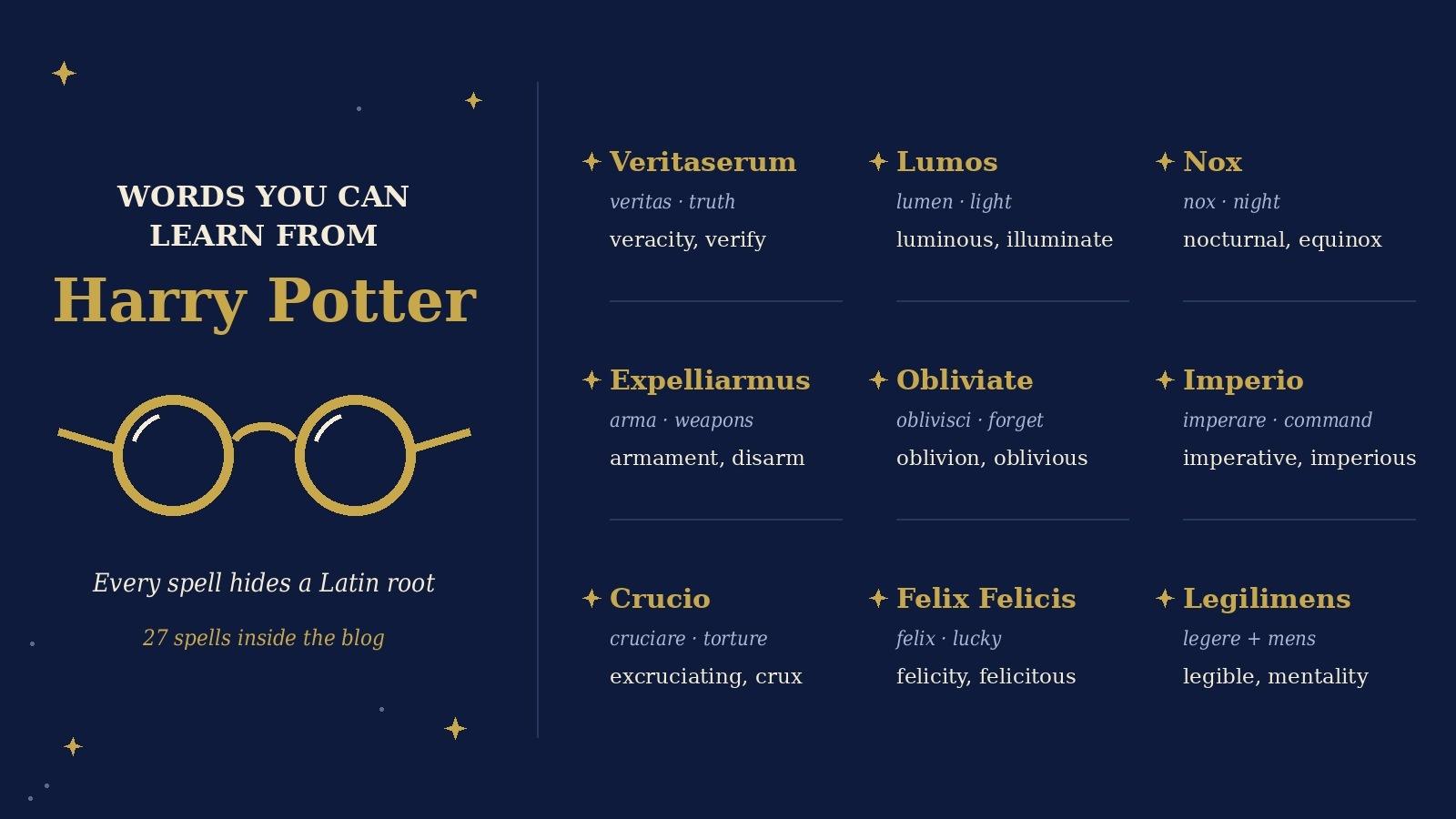
The spells below are grouped by what they do. Learning them in clusters helps, because related meanings reinforce each other. Read across each row: spell, root, meaning, then the English words that grew from it. Say the spell, then say the words; the link forms faster when you hear it.
Truth, mind and memory
| Spell | Latin root | Meaning | Words to learn |
|---|---|---|---|
| Veritaserum | veritas | truth | veracity, verify, verdict |
| Legilimens | legere + mens | to read + mind | legible, mentality |
| Obliviate | oblivisci | to forget | oblivion, oblivious |
| Imperio | imperare | to command | imperative, imperious |
| Confundo | confundere | to mix up | confound, confusion |
| Revelio | revelare | to unveil | reveal, revelation |
| Fidelius | fidelis | faithful | fidelity, infidel |
| Riddikulus | ridere | to laugh | ridicule, deride, derision |
| Felix Felicis | felix | lucky, happy | felicity, felicitous |
Attack and defence
| Spell | Latin root | Meaning | Words to learn |
|---|---|---|---|
| Expelliarmus | expellere + arma | drive out + weapons | expel, armament, disarm |
| Crucio | cruciare | to torture | excruciating, crux |
| Protego | protegere | to protect | protect, protégé |
| Impedimenta | impedimentum | hindrance | impede, impediment |
| Petrificus Totalus | petra | rock | petrify, petrified |
| Sectumsempra | sectum + semper | cut + always | section, bisect, sempiternal |
| Incendio | incendere | to set on fire | incendiary, incense |
| Morsmordre | mors + mordere | death + to bite | mortal, mortify, mordant |
| Expecto Patronum | patronus | protector | patron, patronage |
Everyday magic
| Spell | Latin root | Meaning | Words to learn |
|---|---|---|---|
| Lumos | lumen | light | luminous, illuminate, luminary |
| Nox | nox | night | nocturnal, equinox |
| Accio | ciere | to summon, set in motion | cite, incite, excite |
| Reparo | reparare | to restore | repair, reparation |
| Aguamenti | aqua | water | aquatic, aqueduct, aquifer |
| Wingardium Leviosa | levis | light in weight | levitate, alleviate, levity |
| Tergeo | tergere | to wipe | detergent |
| Locomotor | locus + movere | place + to move | locomotion, locomotive |
| Obscuro | obscurus | dark, hidden | obscure, obscurity |
A worked example
Imagine an RC passage that describes a minister's "imperious dismissal of the committee's findings", followed by a tone question. If "imperious" is unfamiliar, the passage can feel like fog.
Now apply the method. Imperio is the curse that forces obedience. The root is imperare, to command. So an imperious dismissal is a commanding, arrogant one, made by someone who expects to be obeyed. The author is critical of the minister, and the tone options that suggest admiration or neutrality can go.
Three seconds of decoding, one option set narrowed, and no dictionary needed in the exam hall.
Turning this into a daily habit
- One root a day. Write the spell, the root and three English words in a notebook. Twenty-seven days covers the full set.
- Build the family. From "lumen", move to luminous, illuminate and luminary. Families are far easier to keep than isolated words.
- Spot it in reading. Each time a word from your notebook turns up in an editorial or RC passage, mark it. Recognition in real text is what fixes the word.
- Feel the tone. "Excruciating" is never pleasant. "Felicitous" is always positive. "Levity" can be a criticism when the subject is serious. In tone and inference questions, that instinct earns marks.
One caution: not every spell is pure Latin. "Aguamenti" borrows the Spanish spelling of water, "petra" reached Latin from Greek, and some spells are invented blends. Use the spell as the hook, then confirm the meaning and usage in a good dictionary.
FAQs
Can fiction really improve my CAT vocabulary? Yes. Words attached to a story are easier to recall, and fiction supplies the story for free.
Is learning Latin roots still useful? Yes. A large share of academic English comes from Latin, directly or through French, so one root can unlock words you have never seen before.
How many roots should I learn at a time? Nine at a time works well. Master one family before starting the next.
Do I need to have read the books for this to work? No. It helps, because the scenes are already in your head, but the roots and word families work on their own.
Vocabulary rarely improves through effort alone. It improves when words have somewhere to live. If you want that habit built into a structured plan, The Vocabulary Mastery Course takes it further, and S.C.A.L.E. VARC puts those words to work in real passages.