
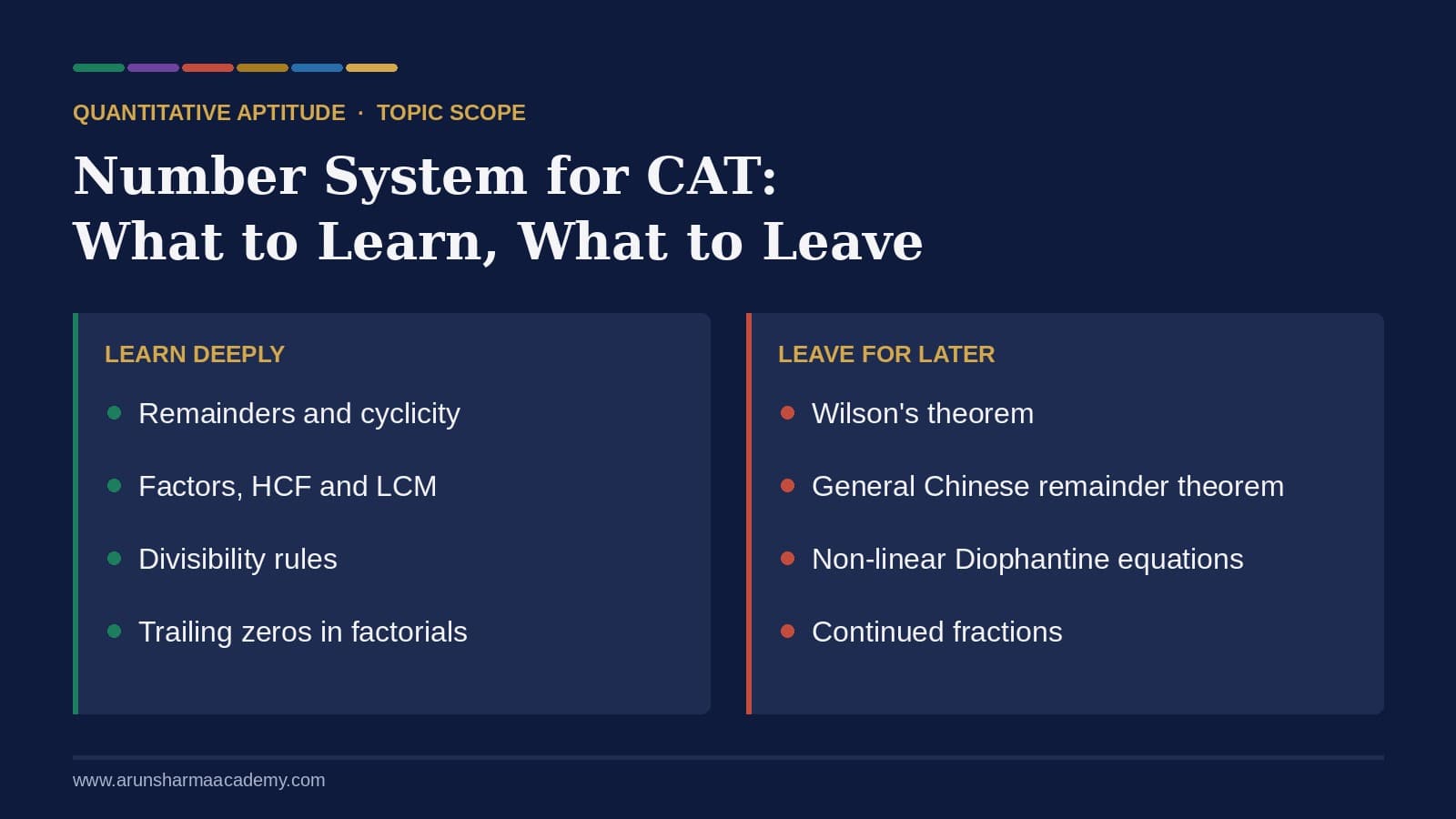
The Number System for CAT: What to Learn Deeply and What to Leave Alone
The number system rewards depth in three places and punishes breadth everywhere else. A scoped study list with the sub-topics that are safe to leave alone.
By Shiva Guru N · 29 September 2026
Number system has a way of swallowing months. The theory is elegant, every chapter unlocks a new trick, and reading it feels like progress in a way arithmetic drills never do. Aspirants come out of it able to state Wilson's theorem and still stall on a factor-counting question in a mock. The number system for CAT is narrower than most textbooks suggest, and knowing where its edges are is worth more than another week inside it.
What should you study in number system for CAT?
Go deep on three areas: remainders, factors and multiples (including HCF and LCM), and divisibility. Learn base systems and surds at a working level only. Heavy theorems and exotic problem types can wait until everything with a higher return is secure.
Remainders: the concepts worth real depth
Remainder questions reward a small set of ideas used well, not a long list of theorems.
Start with the rule that remainders multiply and add. The remainder of a product equals the product of the individual remainders, reduced again by the divisor. That one idea handles most questions built on large products.
Next comes cyclicity. The unit digits of powers repeat in cycles of at most four, and remainders of powers against a fixed divisor also repeat. Finding the cycle turns a question like the unit digit of 7^95 into a lookup: the cycle is 7, 9, 3, 1, and 95 leaves 3 on division by 4, so the answer is 3.
Then negative remainders. Treating 29 as -1 when dividing by 30 makes large powers collapse almost immediately.
Fermat's little theorem earns its place for prime divisors. Beyond that, returns fall off quickly. Euler's theorem is worth recognising, while Wilson's theorem and the general Chinese remainder theorem seldom repay the study time.
Factors, multiples, HCF and LCM
Factor questions recur in a handful of shapes, and each shape has a method.
For counting factors, write the number as a product of primes, add one to each power and multiply. 360 is 2³ × 3² × 5, so it has 4 × 3 × 2 = 24 factors. Variations ask for even factors, odd factors or perfect-square factors, and all of them come from the same prime breakdown.
Next is the highest power of a prime in a factorial, along with its close cousin, trailing zeros. 100! ends in 24 zeros, because 100/5 + 100/25 = 20 + 4.
HCF and LCM word problems follow patterns: bells ringing together, the largest number that leaves the same remainder when dividing several numbers, the smallest number that leaves given remainders. Learn each pattern once and it stops surprising you.
The standard traps sit in the wording. "Leaves the same remainder" and "leaves a remainder of r" call for different operations, and one quick misread turns a solved question into a wrong one.
Base systems, surds and the long tail
Here the judgement shifts from depth to scope.
Base system questions do appear, and the typical one rests on converting between bases or doing simple arithmetic in another base. Learn those two skills. Detailed divisibility theory in arbitrary bases is a poor use of time.
Surds and indices are better treated as algebra. Rationalising denominators and comparing surds is worth an evening. Nested radicals and elaborate simplifications are not.
The rest of the long tail includes continued fractions, Diophantine equations beyond the linear kind, and the collections of named theorems some books present as essential. They are real mathematics. They are just not where CAT marks tend to sit, and every hour there is an hour taken from remainders and factors, which is where they do.
You don't need to take that on trust. The previous-year CAT papers will confirm it or correct it.
The learn / leave list
Learn deeply
- Remainders: product and sum rules, cyclicity, negative remainders, Fermat's little theorem
- Factors: counting factors, even, odd and square factors, sum of factors
- Factorials: highest power of a prime, trailing zeros
- HCF and LCM: the standard word-problem patterns
- Divisibility rules for 2, 3, 4, 5, 8, 9 and 11
Learn at a working level
- Base conversion and arithmetic in other bases
- Surds and indices, basic simplification
- Euler's theorem, enough to recognise when it applies
Leave alone until everything above is secure
- Wilson's theorem and the general Chinese remainder theorem
- Non-linear Diophantine equations
- Continued fractions and nested radicals
- Divisibility theory in arbitrary bases
How number system shows up disguised
Scoping the topic does not shrink it in the paper. Number system ideas turn up inside other questions all the time. An algebra problem asking for integer solutions is often a factors problem. A digit-sum question is divisibility. A word problem about packing items into equal groups is HCF under another name. This is the real reason depth in the core three pays. It earns marks on questions that are not labelled number system at all, and aspirants who skipped the depth rarely spot the connection under exam pressure.
FAQs
How many hours should go into number system for CAT? Fewer than arithmetic, and a number fixed in advance. Set the cap, cover the learn-deeply list inside it, and move on even if the theory still feels unfinished. For a sequenced route, see S.C.A.L.E. QA.
What is the best practice source? Previous-year CAT papers first, because they show the real question style. After that, a graded question bank builds volume on the retained sub-topics.
Has number system become harder in recent CAT papers? Difficulty varies by year and slot, so no single trend holds. Solve the number system questions from recent papers yourself and judge the level directly.
Depth in three places and discipline everywhere else is the whole strategy, and QA 800 supplies the volume that makes the retained list automatic.