
CAT Quant Topic Weightage: Which Areas Return the Most Marks per Study Hour
Well, not every quant topic pays the same return. A marks-per-study-hour reading of the quant syllabus, counted from actual CAT papers rather than guesswork.
By Shiva Guru N · 23 September 2026
Most CAT plans begin with the syllabus printed out and pinned above the desk, to be ticked off from top to bottom. Finishing that list and scoring well are two different projects. The syllabus tells you what can appear. It says nothing about what each topic returns for the hours you give it, and that is what CAT quant topic weightage should really mean. Quant topics have to earn a ranking before they earn your time.
Which quant topics carry the most weightage in CAT?
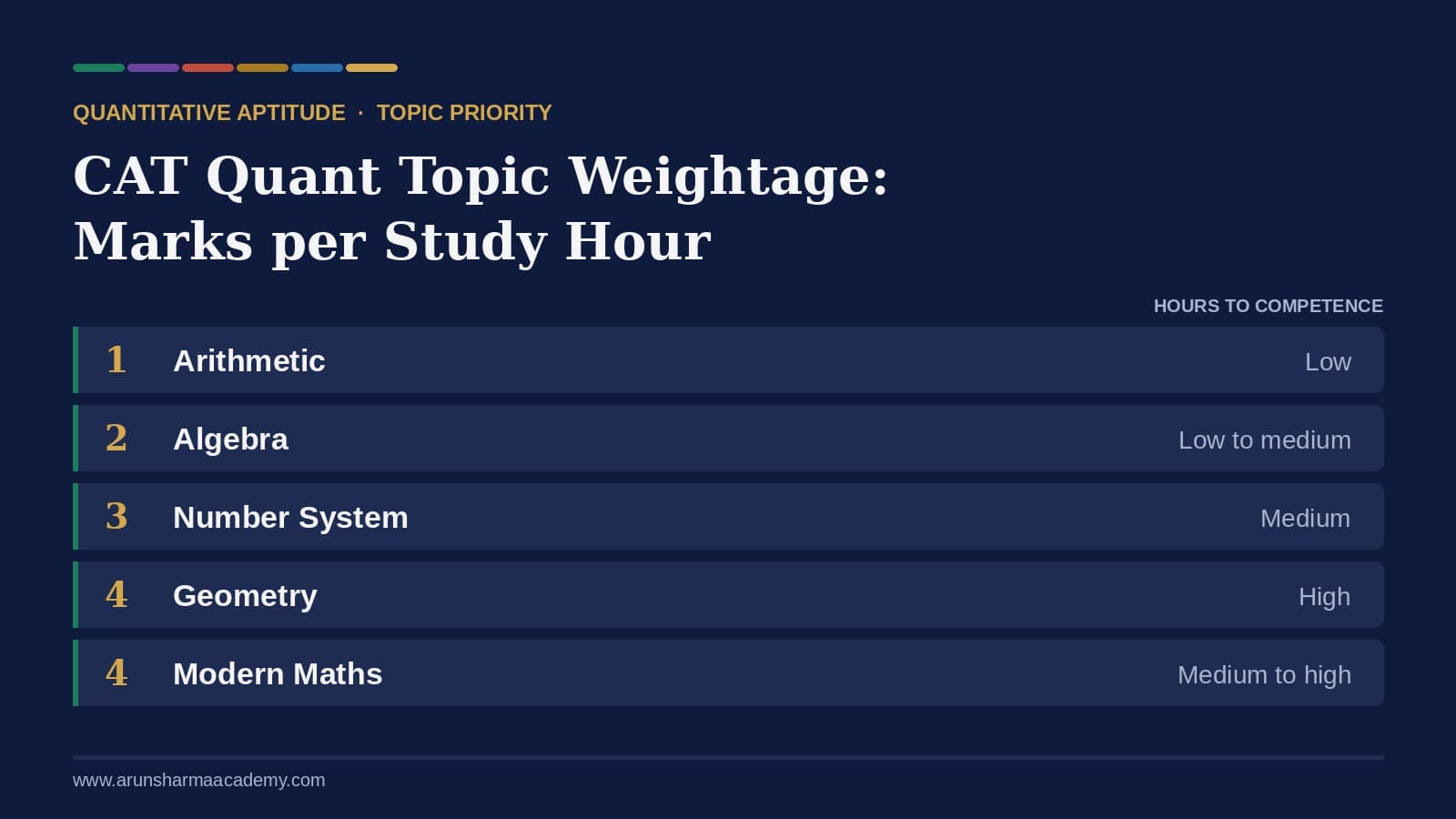
Arithmetic returns the most marks per study hour because it appears on its own and inside other topics. Algebra comes second and Number System third. Geometry and Modern Maths cost more hours per mark, so they need a planned, capped investment.
How to count weightage yourself from past papers
Weightage is countable. It does not have to be taken on anyone's word, including ours.
Open the previous-year CAT papers archive and set aside a weekend. Take the quant section of every paper from 2017 onward, across all slots. Tag each question with one area rather than a sub-topic: Arithmetic, Algebra, Number System, Geometry and Mensuration, Modern Maths. Five tags will cover the lot.
Some questions sit across two areas. Tag those to whichever concept carried the solution and note the overlap separately. That note usually turns out to be the most valuable thing you produce all weekend, because it shows which areas are quietly doing work inside others.
When you total it up, look at the shape rather than the exact figures. You are after three things. Which areas never drop below a floor. Which ones swing hard from one year to the next, and so make a poor foundation for a plan. And how often a question filed under one heading was really decided somewhere else.
A weekend of tallying beats every unsourced weightage list on the internet, for the simple reason that you know how yours was made.
Arithmetic: the compounding area
Arithmetic sits at the top for a reason that has little to do with question count. It compounds.
Ratio and proportion is not really a topic. It is the grammar the rest of the section is written in. Percentage lives inside profit and loss, compound interest, mixtures and nearly every DI set you will ever open. Time, speed and distance is ratio in different clothes. Time and work is the same thing again. Get ratio, percentage and TSD properly right and you haven't learned three topics. You have cut the solving time on a large share of the section.
The effect spills into DILR as well. A set built around a table of values is arithmetic with a reasoning wrapper, and a student fluent in ratios reads that table faster than one who isn't. She earns the advantage in a section she wasn't even revising for.
That is why weak preparations should begin here and strong ones should keep coming back.
Algebra and Numbers: the middle tier
Algebra earns its hours, though selectively. Linear and quadratic equations, inequalities, functions and the basics of logarithms carry the weight. Maxima and minima appear often enough to deserve attention. The long tail of exotic equation forms looks impressive in a textbook and rarely survives into a paper.
Number System is where aspirants overspend most reliably. The theory is satisfying, reading it feels like progress, and it is easy to lose a month in there without noticing. Remainders, factors and divisibility deserve real depth. Base systems and the curiosities around them do not, at least not until the higher-return areas are secure.
The test is the same for both. If a sub-topic appears rarely and takes a week to learn, it is a rabbit hole however interesting it happens to be.
Geometry and Modern Maths: the honest trade-off
Geometry is where marks per hour gets uncomfortable, because the questions are not rare. They are expensive. Geometry rewards accumulated exposure to patterns more than anything else in quant, so the hours go in long before the marks come out, sometimes by months.
Partial coverage is a defensible choice here, as long as it is a decision rather than a drift. Triangles, circles and coordinate basics cover most of what turns up, while deep solid geometry and elaborate construction problems can wait or be left alone. For structured practice on the core areas, see the Geometry Mastery Course.
Modern Maths is smaller and more volatile. Progressions are cheap to learn and worth doing early. Permutations, combinations and probability deserve a capped investment rather than an open-ended one.
Reading the priority list: marks per hour, not marks
This is a priority order, not a prediction. Beside each area, write in your own count from the 2017 to 2025 papers. Once that is done, the list becomes something you can defend rather than something you were handed.
- Arithmetic: appears directly and inside DI, TSD, mixtures and work. Hours to competence: low.
- Algebra: standalone questions plus the setup for word problems. Hours to competence: low to medium.
- Number System: concentrated in three sub-topics, with an optional long tail. Hours to competence: medium.
- Geometry: heavy on pattern exposure, so hours arrive before marks. Hours to competence: high.
- Modern Maths: small and high-variance, with progressions as the cheap win. Hours to competence: medium to high.
Weightage shifts from year to year. Priority order shifts far less, because it is driven by how concepts feed each other rather than by the make-up of any single paper. Work the middle tier with the Algebra Mastery Course once your own count is in front of you.
FAQs
Can a quant topic be skipped entirely? Skipping an area is rarely wise. Capping one often is. Decide how many hours a low-return area gets before you start it, then stop there rather than abandoning it halfway.
What order should the areas be studied in? Arithmetic, then Algebra, then Number System, with Geometry running alongside from early on because it needs exposure time. Modern Maths last, and scoped.
Is geometry harder for non-engineers? No. It is harder for anyone who last met it in school and hasn't practised since, which includes a great many engineers.
How should revision be weighted? In the same proportion as study, not evenly. Arithmetic revision compounds across the whole section. A final-month pass over rarely appearing sub-topics does not.
Study order decides more of a score than study hours do, and S.C.A.L.E. QA is the place to work through that order in sequence, with arithmetic at the start and returned to right through the year.