
How to Calculate Faster in CAT Without Reaching for the On-Screen Calculator
The CAT on-screen calculator costs more time than it saves. The conversions, approximation rules and daily drill that cut minutes off your quant section without losing accuracy.
By Shiva Guru N · 21 September 2026
Every CAT aspirant knows the on-screen calculator is there, and that is exactly the problem. It sits one click away, so it gets used for sums a Class 8 student could do in their head. Click, type, check, retype, go back to the question. Repeat that thirty or forty times across a section and several minutes have gone on arithmetic you already knew. Calculation speed for CAT has far less to do with becoming a human computer than with breaking that habit.
How do you improve calculation speed for CAT?
Speed comes from recognition, not faster hands. Know the common fractions, squares, cubes and roots cold, round whenever the answer options allow it, and save the calculator for genuinely ugly numbers. Give that combination a few weeks of daily practice.
Where the time really disappears in a quant section
Forty minutes for the quant section feels generous until you audit one. Take your last sectional or mock and, for five questions, note roughly how long went into four stages: reading the question, setting it up, computing, and re-checking.
Most aspirants find the same thing. Setting up is rarely the leak. Computing and re-checking are. The calculator makes both worse, because every number typed in has to be read back, and one mistyped digit sends you round the loop again.
There is a second cost that is harder to see. Every switch between the question and the calculator breaks your line of thought. You come back to the problem and reread the last line just to find your place. None of this shows up as a wrong answer, which is why it survives for months. It shows up as the question you never reached at minute thirty-eight.
Fixing it starts with the numbers you should never have to compute at all.
The four conversions worth knowing cold
Four sets of numbers do most of the heavy lifting in CAT quant and DI. Learn them until recall is instant, not merely quick.
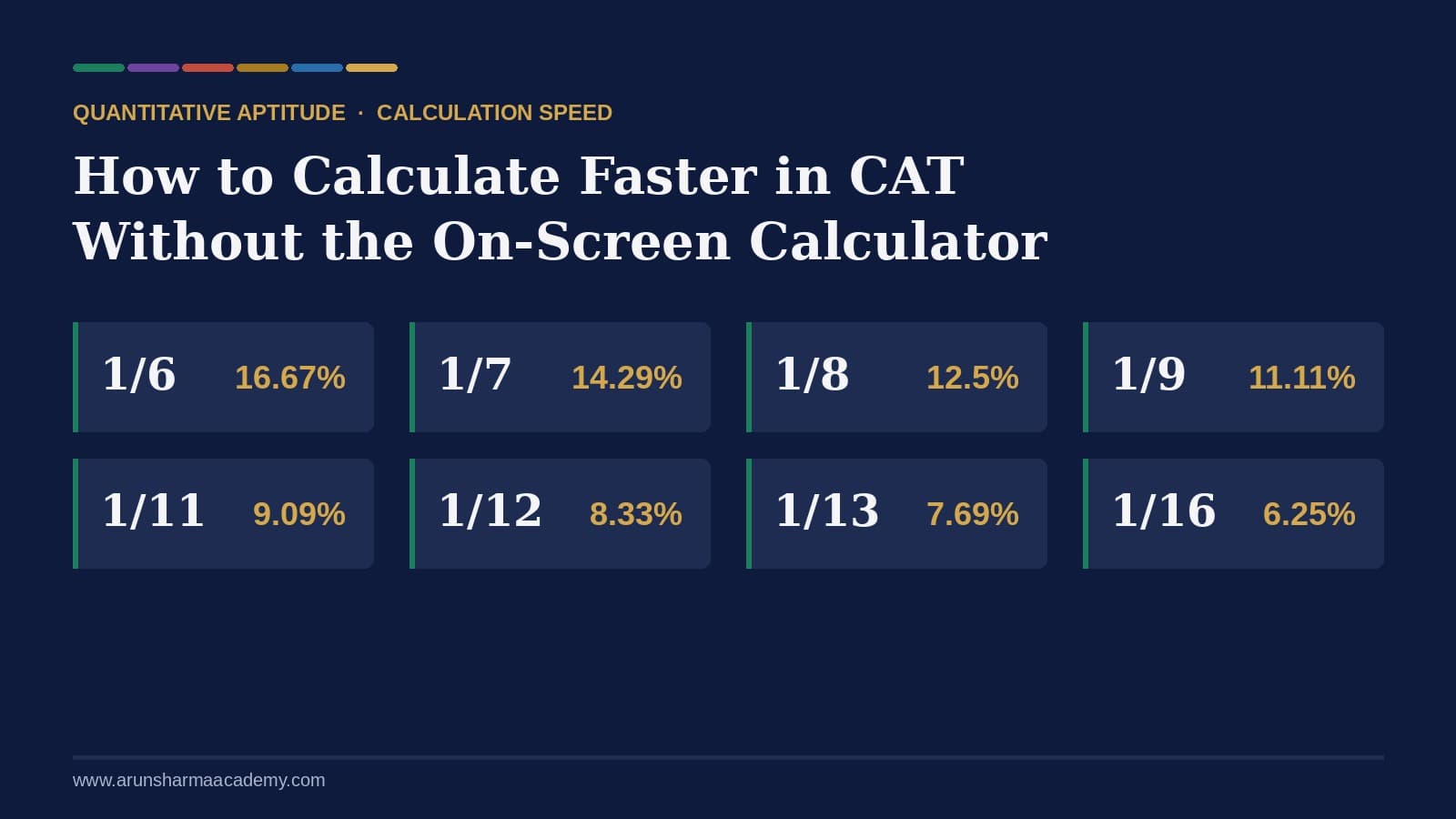
- Fractions to percentages: 1/6 = 16.67%, 1/7 = 14.29%, 1/8 = 12.5%, 1/9 = 11.11%, 1/11 = 9.09%, 1/12 = 8.33%, 1/13 ≈ 7.69%, 1/14 ≈ 7.14%, 1/15 = 6.67%, 1/16 = 6.25%. Once these are automatic, a 14.29% increase stops being a calculation and becomes "multiply by 8/7".
- Squares up to 30. Most people stop at 20. The squares from 21 to 30 turn up in right triangles, area questions and quadratic roots often enough to repay the effort.
- Cubes up to 15. Useful in mensuration, number system and any question hiding a cube root.
- Common roots: √2 ≈ 1.414, √3 ≈ 1.732, √5 ≈ 2.236. These three settle most geometry answers that arrive in surd form.
The point is not memory for its own sake. Each item you know removes a trip to the calculator, and each trip removed keeps you inside the problem.
Approximation: deciding when exact is not required
The answer options tell you how precise you need to be. Most aspirants read them last. Read them first.
If the four options are 312, 348, 391 and 427, they sit roughly forty apart. You can round every number in your working to two significant figures and still land on the right one. If the options are 312, 315, 318 and 321, rounding will betray you, and you should either work exactly or consider leaving the question.
A simple rule covers most cases. Look at the gap between the two closest options as a share of their size. If that gap is comfortably larger than the error your rounding introduces, round. If it is not, don't.
Two habits make approximation safe. Round in opposite directions where you can, one number up and one down, so the errors partly cancel. And keep track of which way you rounded, so that if two options survive you know which side of your estimate the true answer lies on.
A 21-day drill that fits in ten minutes
Ten minutes a day, same time each day, with a stopwatch running.
- Days 1 to 7: fraction-percentage pairs and squares to 30. Write them out from memory, check, and mark the ones you missed.
- Days 8 to 14: cubes to 15, the three roots, and two-digit multiplication done mentally. Time yourself on a set of ten.
- Days 15 to 21: approximation. Take ten old quant or DI questions, estimate the answer from the options alone, then check against the key.
Measure one thing throughout: how many items you get right in the ten minutes. The number should rise week on week. If it stalls, repeat that week before moving on.
When the on-screen calculator is the right call
None of this makes the calculator the enemy. Long division with awkward divisors, decimals that refuse to round cleanly, and DI tables where the options sit close together all justify reaching for it. So does any calculation you would otherwise do twice because you don't trust your first attempt. The aim is to use it deliberately for the ugly numbers rather than reflexively for every number. Aspirants who scrap it altogether often swap a time problem for an accuracy problem.
FAQs
Is Vedic maths worth learning for CAT? A few of its techniques, such as squaring numbers close to a base, are genuinely useful. Learning the full system is not necessary. Pick the handful that suit CAT-style numbers and leave the rest.
How long does it take to improve calculation speed? Give the drill at least three weeks before judging it. The real measure is fewer calculator trips per section, which you can track from your own mocks.
Should I use the calculator in DILR? Yes, when the numbers call for it. DI tables often carry messy percentages where an exact figure matters. The same rule applies as in quant: approximate when options are far apart, calculate when they are close.
Calculation speed is a habit built in ten-minute blocks, and the Arithmetic Mastery Course is where that habit gets applied to the topics that use it most, with QA 800 and the must-know CAT formulae alongside for volume.