
CAT previous-year paper
CAT 2020 DILR Slot 1 Question Paper
Work through all 24 Data Interpretation and Logical Reasoning questions from this paper. Passages and data sets appear once, followed by their related questions.
Read the passage or information below
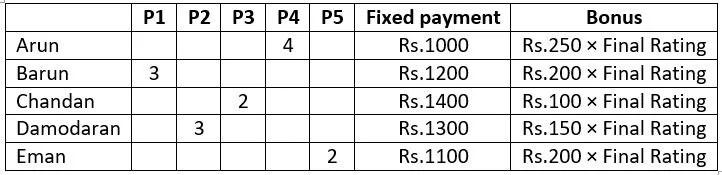
The local office of the APP-CAB company evaluates the performance of five cab drivers, Arun, Barun, Chandan, Damodaran, and Eman for their monthly payment based on ratings in five different parameters (P1 to P5) as given below: P1: timely arrival P2: behaviour P3: comfortable ride P4: driver's familiarity with the route P5: value for money Based on feedback from the customers, the office assigns a rating from 1 to 5 in each of these parameters. Each rating is an integer from a low value of 1 to a high value of 5. The final rating of a driver is the average of his ratings in these five parameters. The monthly payment of the drivers has two parts – a fixed payment and final rating-based bonus. If a driver gets a rating of 1 in any of the parameters, he is not eligible to get bonus. To be eligible for bonus a driver also needs to get a rating of five in at least one of the parameters. The partial information related to the ratings of the drivers in different parameters and the monthly payment structure (in rupees) is given in the table below: The following additional facts are known. 1. Arun and Barun have got a rating of 5 in exactly one of the parameters. Chandan has got a rating of 5 in exactly two parameters. 2. None of drivers has got the same rating in three parameters.
Question 1
If Damodaran does not get a bonus, what is the maximum possible value of his final rating?
- A.3.4
- B.3.6
- C.3.8
- D.3.2
View answer
Correct answer: B. 3.6
Question 2
If Eman gets a bonus, what is the minimum possible value of his final rating?
- A.3.4
- B.3.2
- C.3
- D.2.8
View answer
Correct answer: C. 3
Question 3
If all five drivers get bonus, what is the minimum possible value of the monthly payment (in rupees) that a driver gets?
- A.1600
- B.1700
- C.1740
- D.1750
View answer
Correct answer: B. 1700
Question 4
If all five drivers get bonus, what is the maximum possible value of the monthly payment (in rupees) that a driver gets?
- A.1960
- B.1950
- C.1900
- D.2050
View answer
Correct answer: A. 1960
Read the passage or information below
Four institutes, A, B, C, and D, had contracts with four vendors W, X, Y, and Z during the ten calendar years from 2010 to 2019. The contracts were either multi-year contracts running for several consecutive years or single-year contracts. No institute had more than one contract with the same vendor. However, in a calendar year, an institute may have had contracts with multiple vendors, and a vendor may have had contracts with multiple institutes. It is known that over the decade, the institutes each got into two contracts with two of these vendors, and each vendor got into two contracts with two of these institutes. The following facts are also known about these contracts. I. Vendor Z had at least one contract in every year. II. Vendor X had one or more contracts in every year up to 2015, but no contract in any year after that. III. Vendor Y had contracts in 2010 and 2019. Vendor W had contracts only in 2012. IV. There were five contracts in 2012. V. There were exactly four multi-year contracts. Institute B had a 7-year contract, D had a 4-year contract, and A and C had one 3-year contract each. The other four contracts were single-year contracts. VI. Institute C had one or more contracts in 2012 but did not have any contract in 2011. VII. Institutes B and D each had exactly one contract in 2012. Institute D did not have any contract in 2010.
Question 5
In which of the following years were there two or more contracts?
- A.2017
- B.2018
- C.2016
- D.2015
View answer
Correct answer: D. 2015
Question 6
Which of the following is true?
- A.B had a contract with Y in 2019
- B.D had a contract with X in 2011
- C.B had a contract with Z in 2017
- D.D had a contract with Y in 2019
View answer
Correct answer: D. D had a contract with Y in 2019
Question 7
In how many years during this period was there only one contract?
- A.3
- B.4
- C.2
- D.5
View answer
Correct answer: A. 3
Question 8
What BEST can be concluded about the number of contracts in 2010?
- A.exactly 3
- B.at least 3
- C.at least 4
- D.exactly 4
View answer
Correct answer: A. exactly 3
Question 9
Which institutes had multiple contracts during the same year?
- A.B and C only
- B.A only
- C.B only
- D.A and B only
View answer
Correct answer: D. A and B only
Question 10
Which institutes and vendors had more than one contracts in any year?
- A.B, W, X, and Z
- B.B, D, W, and X
- C.A, B, W, and X
- D.A, D, W, and Z
View answer
Correct answer: C. A, B, W, and X
Read the passage or information below
In a certain board examination, students were to appear for examination in five subjects: English, Hindi, Mathematics, Science and Social Science. Due to a certain emergency situation, a few of the examinations could not be conducted for some students. Hence, some students missed one examination and some others missed two examinations. Nobody missed more than two examinations. The board adopted the following policy for awarding marks to students. If a student appeared in all five examinations, then the marks awarded in each of the examinations were on the basis of the scores obtained by them in those examinations. If a student missed only one examination, then the marks awarded in that examination was the average of the best three among the four scores in the examinations they appeared for. If a student missed two examinations, then the marks awarded in each of these examinations was the average of the best two among the three scores in the examinations they appeared for. The marks obtained by six students in the examination are given in the table below. Each of them missed either one or two examinations. English Hindi Mathematics Science Social Science Alva 80 75 70 75 60 Bithi 90 80 55 85 85 Carl 75 80 90 100 90 Deep 70 90 100 90 80 Esha 80 85 95 60 55 Foni 83 72 78 88 83 The following facts are also known. I. Four of these students appeared in each of the English, Hindi, Science, and Social Science examinations. II. The student who missed the Mathematics examination did not miss any other examination. Ill. One of the students who missed the Hindi examination did not miss any other examination. The other student who missed the Hindi examination also missed the Science examination.
Question 11
Who among the following did not appear for the Mathematics examination?
- A.Carl
- B.Alva
- C.Esha
- D.Foni
View answer
Correct answer: A. Carl
Question 12
Which students did not appear for the English examination?
- A.Cannot be determined
- B.Alva and Bithi
- C.Carl and Deep
- D.Esha and Foni
View answer
Correct answer: D. Esha and Foni
Question 13
What BEST can be concluded about the students who did not appear for the Hindi examination?
- A.Two among Alva, Deep and Esha
- B.Alva and Esha
- C.Alva and Deep
- D.Deep and Esha
View answer
Correct answer: C. Alva and Deep
Question 14
What BEST can be concluded about the students who missed the Science examination?
- A.Deep and Bithi
- B.Alva and Bithi
- C.Alva and Deep
- D.Bithi and one out of Alva and Deep
View answer
Correct answer: D. Bithi and one out of Alva and Deep
Question 15
How many out of these six students missed exactly one examination?
View answer
Correct answer: 3
Question 16
For how many students can we be definite about which examinations they missed?
View answer
Correct answer: 4
Read the passage or information below
Ten musicians (A, B, C, D, E, F, G, H, I and J) are experts in at least one of the following three percussion instruments: tabla, mridangam, and ghatam. Among them, three are experts in tabla but not in mridangam or ghatam, another three are experts in mridangam but not in tabla or ghatam, and one is an expert in ghatam but not in tabla or mridangam. Further, two are experts in tabla and mridangam but not in ghatam, and one is an expert in tabla and ghatam but not in mridangam. The following facts are known about these ten musicians.
Question 17
Who among the following is DEFINITELY an expert in tabla but not in either mridangam or ghatam?
- A.A
- B.F
- C.H
- D.C
View answer
Correct answer: C. H
Question 18
Who among the following is DEFINITELY an expert in mridangam but not in either tabla or ghatam?
- A.B
- B.J
- C.G
- D.E
View answer
Correct answer: B. J
Question 19
Which of the following pairs CANNOT have any musician who is an expert in both tabla and mridangam but not in ghatam?
- A.A and B
- B.F and G
- C.C and E
- D.C and F
View answer
Correct answer: C. C and E
Question 20
If C is an expert in mridangam and F is not, then which are the three musicians who are experts in tabla but not in either mridangam or ghatam?
- A.E, F and H
- B.C, G and H
- C.E, G and H
- D.C, E and G
View answer
Correct answer: A. E, F and H
Read the passage or information below
1000 patients currently suffering from a disease were selected to study the effectiveness of treatment of four types of medicines — A, B, C and D. These patients were first randomly assigned into two groups of equal size, called treatment group and control group. The patients in the control group were not treated with any of these medicines; instead they were given a dummy medicine, called placebo, containing only sugar and starch. The following information is known about the patients in the treatment group. a. A total of 250 patients were treated with type A medicine and a total of 210 patients were treated with type C medicine. b. 25 patients were treated with type A medicine only. 20 patients were treated with type C medicine only. 10 patients were treated with type D medicine only. c. 35 patients were treated with type A and type D medicines only. 20 patients were treated with type A and type B medicines only. 30 patients were treated with type A and type C medicines only. 20 patients were treated with type C and type D medicines only. d. 100 patients were treated with exactly three types of medicines. e. 40 patients were treated with medicines of types A, B and C, but not with medicines of type D. 20 patients were treated with medicines of types A, C and D, but not with medicines of type B. f. 50 patients were given all the four types of medicines. 75 patients were treated with exactly one type of medicine.
Question 21
How many patients were treated with medicine type B?
View answer
Correct answer: 340
Question 22
The number of patients who were treated with medicine types B, C and D, but not type A was:
View answer
Correct answer: 10
Question 23
How many patients were treated with medicine types B and D only?
View answer
Correct answer: 150
Question 24
The number of patients who were treated with medicine type D was:
View answer
Correct answer: 325